
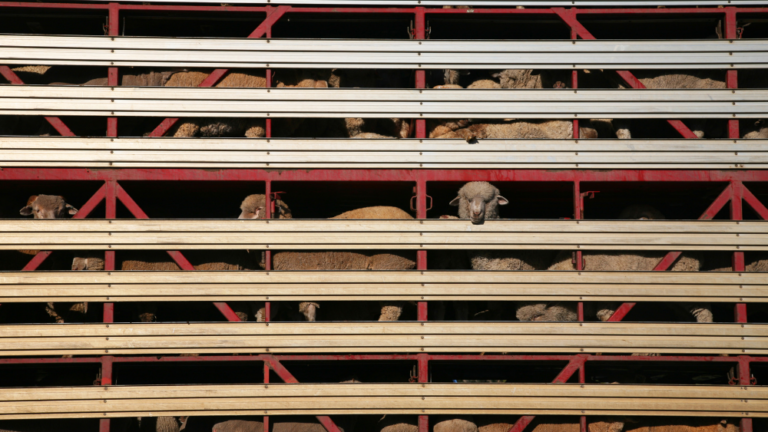
As the representative of the Animal Rights Center Japan, the very first time I was shocked by the reality of livestock was when I saw a small photo of live export in a third-grade social studies textbook, used as an illustrative photo of industry.
Cattle being loaded onto a ship.
I thought it looked like the slave trade.
Since joining the Animal Rights Center, I have learned that there is suffering, pain, and tragedy that far exceeds the shock I felt from that single photo.
To put it in simple terms, over 2.5 million animals have died on board ships over the past 30 years. These figures show just how harsh, brutal, and merciless live transport is.
Nearly 40 years after seeing that photo in the textbook, this industry is nearing its end.
Starting with Luxembourg’s ban on the transport of live animals to third countries for slaughter, New Zealand and the UK have followed suit with their own bans.
I believe the photo in my elementary school textbook was from Australia, and even there, the live export of sheep will be banned in 2028.
However, even if some countries ban it, the same practices will continue unless the whole world bans it.
The World Organisation for Animal Health (WOAH) is currently in the process of revising its standards for live transport. It should be banned here.
The Japanese government should firmly support the ban.
Furthermore, the nature of long-distance transport within Japan should be reviewed.
Currently, WOAH (World Organisation for Animal Health) is reviewing Chapter 7.2, “Animal Welfare During Transport,” of the Terrestrial Animal Health Code. Within the Ministry of Agriculture, Forestry and Fisheries, there is a department responsible for WOAH, and Japan will submit its opinion; we have submitted our comments regarding this.
Comments on the WOAH Consultation Document Draft Chapter 7.2 “Animal Welfare During Transport”
Dear Sir
We welcome the fact that the World Organisation for Animal Health (WOAH) is currently revising its animal transport standards, particularly the development of the consolidated Chapter 7.2 regarding “Animal Welfare During Transport.” We would like to take this opportunity to make several recommendations.
From your position as Japan’s representative to WOAH, we ask that you utilize this revision to support stronger standards based on the accumulated findings of animal welfare science*, which demonstrate that long-distance live animal transport causes significant burden and distress to animals.
In recent years, policy progress toward ending live transport has been seen worldwide, including live export bans in the UK and New Zealand, the scheduled ban on live sheep exports by sea in Australia, and the suspension of live export certificates to certain third countries in Germany.
We welcome all effective measures that lead to improved animal welfare and shorter transport times. From this perspective, as a WOAH member country, we hope that you will utilize this revision as an important opportunity to strengthen international standards for animal welfare.
Both the current Terrestrial Animal Health Code and the draft consolidated Chapter 7.2 clearly state:
“The risk to animal welfare increases as the duration of transport increases.”
“Transport should be as short as possible.”
These principles are explicitly mentioned.
We request that these principles be reflected in the revision of global animal transport standards, and that, domestically, you coordinate with relevant ministries to consider and promote a shift toward the distribution of meat, carcasses, milk powder, embryos, and semen as alternatives to live transport. Furthermore, we expect Japan to support international efforts toward the phased reduction and replacement of long-distance live transport through discussions at WOAH.
Animal Welfare Issues Caused by Long-Distance Transport
As recent reports indicate, geopolitical factors have led to cases where vessels transporting cattle and sheep are headed toward conflict zones. As a result, crews and animals are exposed to risks of long delays, injury, and death.
Particularly in sea transport, the following issues are repeatedly reported:
- Massive accumulation of excrement
- Contaminated bedding
- Unsanitary drinking and feeding facilities
- Overcrowding
- High temperature and humidity
- Inadequate ventilation
- Cases requiring injury treatment and euthanasia
These problems are frequently documented.
Furthermore, long-distance land transport also results in:
- Fatigue
- Dehydration
- Stress
- Injuries
- Trampling accidents
And other injuries.
Moreover, long-distance transport in overcrowded and unsanitary environments weakens immune functions and increases the risk of transmitting diseases, including zoonoses.
Inherent Animal Welfare Challenges in Long-Distance Transport
While strengthening WOAH standards is important, a statement released by the South African Veterinary Association (SAVA) in April 2026 points out that inherent animal welfare problems exist in long-distance sea transport. SAVA states the following:
“Inherent harms are those that are an unavoidable accompaniment to any voyage and include the motion of the vessel, the difficulty of managing large numbers of animals, and the accumulation of excreta and ammonia.”
Furthermore,
They conclude that “the inherent harms associated with live sea transport and the resulting animal suffering cannot be prevented by any regulation.”
This is their conclusion.
Based on these inherent problems, we believe that the world as a whole should move away from long-distance live transport.
Recommendations Regarding the WOAH Draft
We propose the following four points:
1. Presence of a Veterinarian on Board
A veterinarian should be on board for sea transport exceeding three days. Without a veterinarian, it is impossible to respond appropriately to disease outbreaks or injured animals.
2. Protection of Vulnerable Animals
Transport of the following vulnerable animals should be as short as possible:
- Pregnant animals
- Nursing or unweaned animals
- Animals at the end of their productive lives, such as cull cows or retired breeding sows
3. Prohibition of Transport Without Clear Guarantee of Acceptance
Refusal of acceptance by the buyer or the importing country is a major cause of animals being stranded at sea for weeks or months. Therefore, exporting authorities should not permit transport unless:
- The importing country’s authorities
- The buyer
Have both submitted appropriate guarantees of acceptance.
4. Use of Appropriate Transport Vessels
Many livestock carriers are aging and were not originally designed for transporting livestock. Therefore:
- Vessels 30 years old or older**
- Vessels converted from other uses
Should not be used for animal transport unless strict inspections confirm they meet WOAH standards.
Conclusion
We request that Japan actively participate in the consultation process for this WOAH transport standard revision and support the formulation of stronger international standards. We also hope that you will promote the strict implementation of animal protection standards domestically.
This is vital for:
- Improving animal welfare
- Reducing disease risks
- Preventing the transport of animals to conflict zones
These are the key reasons.
Furthermore, we hope that this revision will be a step toward promoting the transition from long-distance live transport to the transport of meat, carcasses, milk powder, and genetic resources.
Sincerely,