
The number of blood release failures, which can be considered the percentage of slaughter failures, has been released by the Ministry of Health, Labor and Welfare’s Meat Reduction Survey. What happened to the numbers in 2023 and 2024, when the situation worsened significantly and the number of sacrificed birds exceeded 700,000?
What is poor blood release?
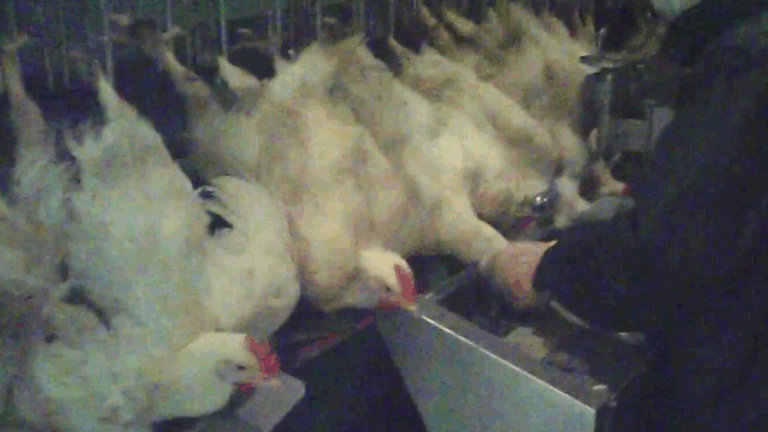
It refers to the worst kind of killing, in which the head is not cut off at the time of slaughter, the blood is not drained, and the animal is boiled alive in boiling water, leaving its skin red and pink from the burns all over its body. We have been alarmed by the fact that this number has been increasing year after year in Japan, despite the fact that it is almost non-existent in the rest of the world or has been greatly reduced in the United States. The high number of bloodletting failures means that the level of slaughter is low and the animals have suffered to the extreme. In some countries, animals are penalized for being put into boiling water while still alive at the time of slaughter, which is illegal.
What happened in 2024?
The overall figure of 675,712 was slightly lower than in 2023, but the number of casualties remained high. The decrease was in the number of egg-laying hens sacrificed at slaughterhouses for waste hens, while meat chickens rather increased in both number and percentage of sacrifices. For meat chickens alone, 490,805 were put into boiling water alive, an increase of 16,242 from 2023.
Meat chickens continue to deteriorate
With over 750 million meat chickens slaughtered annually, even 0.001% has a huge impact and we should be more careful and do our utmost to avoid failure. But now, slaughtering in these meat chickens is becoming a chore, or perhaps there is a decline in awareness, and it is getting worse.
Let’s look at the slaughterhouses in order from the one with the highest percentage of poor bloodletting = terrible slaughterhouses.
Ibaraki: 0.3877% with 12165 birds, worse from 2023 (0.1519% and 4188 birds in the previous year). This is the result of S Factory Chiba Co. and its poultry slaughterhouse in Mito. Something is happening, and it is doubling.
Osaka: 1315 birds at 0.2580%, also worse here (0.2079% and 1078 in the previous year). The results for Bird-Pin Co.
Ehime: 9618 birds at 0.2295%, the result of Maruha Foods, Inc.
Fukuoka: 3248 birds at 0.1744%, Arai Corporation, Agricultural Cooperative Fukuei Kumiai, Tri-an Foods, Inc.
Miyazaki: 239323 birds at 0.1669%, worsening from 2023 (0.1024% 147665 birds in the previous year). (The results are from Ebisu Trading Co., Ltd, Koyu Chicken Shokudo Miyakonojo Plant, Miyazaki Kumiai Chicken Foods Co.
Okinawa: 6351 birds at 0.1658%, the result of the Nago City poultry slaughter facility.
Gifu: 4707 birds at 0.1142%, the result of Gifu Agri Foods Corporation, Cochin Millise Corporation, and Tono Meat Center, an agricultural cooperative.
Tottori: 19965 birds at 0.1001%, worsening from 2023 (0.0893% 17925 birds in the previous year). This is the result of Itoham Yonekyu Holdings Corporation, Nawa Shokudo Chicken, and Daisen Dori Co.
Mie Prefecture improved significantly to nearly zero at 0.0021%. Other prefectures that improved by more than 0.05% were Aomori and Fukushima, while Kagoshima and Niigata improved slightly. While some prefectures improved, the number of deteriorations was much larger than the number of declines in the above prefectures. This deterioration and improvement repeats itself somewhat every year. This means that no systemic or organizational improvements are being made. In other words, awareness is low.
Kagoshima is an outlier for egg-laying hens
Anyway, Kagoshima Prefecture has been an anomaly continuously since the previous year. There are four slaughterhouses in Kagoshima: N Chicken Corporation, Marui Foods Corporation, Noda Plant No. 2, and Nikko Shokotori Matsumoto Plant Ltd. Since no individual figures are reported in the statistical data, it is unclear which slaughterhouse’s figures are abnormal. In any case, these four companies together sacrificed 74,836 birds, which accounts for 40% of the egg-laying hens. Some may argue that this may be due to the large number of slaughtered chickens, but the percentage of defective bloodletting is too high compared to the 17,935,271 slaughtered in Ibaraki Prefecture, which slaughters far more chickens than Kagoshima Prefecture. Ibaraki Prefecture slaughters fewer than 10,000 birds, with 9,804 birds, or 0.0547%.
| Abandoned egg-laying hens in Kagoshima | Percentage of poor blood release | Number of defective blood releases | Overall number of slaughtered | Percentage of poor blood release within egg-laying hens |
| Year 2023 | 0.9471% | 106,552 birds | 11,250,697 birds | 47% |
| Year 2024 | 0.7078% | 74,836 birds | 10,573,297 birds | 40% |
Then in order of percentage,
Tokushima Prefecture (Ondan Agricultural Cooperative, Chicken Production Area Grading, Packaging and Distribution Center) 0.4205%.
Aichi Prefecture (General Incorporated Association Shirai Foods, Marubun Makino Shoten Corporation, Rokutsumi Poultry Chicken Processing Cooperative) 0.3743
0.3676% in Niigata Prefecture (Niigata Portree Business Cooperative)
Hyogo Prefecture (Inan Chicken Farmers Cooperative Association, Poultry Meat Center Y.K., Arinobe Yachiyo Plant) 0.3332
Okinawa Prefecture (Okinawa Poultry and Poultry Distribution Center Co.
followed by Hokkaido, Okayama, and Gunma.
Significant improvements were seen in Osaka and Kagawa prefectures.
Challenges continue
In an age when there is a strong demand to reduce food loss, not only food but lives are being suffered and lost. Domestic chicken meat is now being subjected to unethical processes in many ways during the production process. Animal welfare compliance is also beneficial to poultry slaughterhouses. It can reduce the physical and mental burden on employees and prevent turnover. The animal welfare compliance means the introduction of air-controlled air stunting CAS.
One of the fundamental solutions is the introduction of such a system, but until this is done, a dedicated animal welfare person must be assigned to the slaughter line to carefully watch for chickens that have failed to slaughter, and if one is found, it must be removed and euthanized immediately. This is a general provision of the World Organization for Animal Health’s code, so it should be done at the very least. It is no small task to keep a concentrated watch on all the chickens that flow in at a fairly fast pace for several hours. That is why the system needs to be modified.
675,000 birds, this huge number. An overwhelming number. That many, suffering. Imagine that.
For the sake of the trembling, frightened, and struggling chickens, I sincerely hope for the earliest possible improvement.