
30% of surveyed companies have developed animal welfare policies
The Animal Rights Center (ARC) has released its “FARMWISE Impact 2026” study of 107 food companies considered to have a high impact in the livestock sector in the Japanese market. The number of companies with an explicit company-wide animal welfare policy reached 31.2%; given that companies with policies were virtually non-existent 10 years ago, this represents a significant change over the past decade. On the other hand, the median overall score was only 3, indicating that the transition from a philosophy to a system is still in progress. In particular, efforts in the poultry industry are lagging behind, with the median score for restaurants at 1 point and 2 points for wholesale trading companies, revealing a disparity between industries.
Survey Methodology and Results: https: //arcj.org/farmwise/
From Idea to Institution – to the stage where effectiveness is questioned
FARMWISE Impact evaluates not merely the existence of a philosophy or declaration, but whether it functions as a system, including the specific implementation system, its application to the supply chain, risk management, and the level of information disclosure. While the results of this survey indicate that animal welfare is beginning to be recognized as a corporate management issue to a certain degree, only a limited number of companies have established it as an effective mechanism.
Clear differences by livestock type – Poultry has 3.7% policy retention rate
By field, there are significant differences in the progress of the response.
Eggs: 22.4% ・Fisheries: 9.3% ・Pork: 8.4
Chicken: 3.7%.
While certain initiatives are widespread in the egg sector, poultry meat remains at an extremely low level. It is clear that the animal welfare efforts of Japanese companies are significantly skewed depending on the type of livestock.
Disparities between industries are clear.
The overall scores by industry are as follows
Retail: average 5.28 points (median 4 points) – Manufacturing: average 5.15 points (median 3 points)
– Wholesale Wholesale trading companies: average 2.77 points (median 2 points) – Food service: average 2.23 points (median 1 point)
The retention rate of company-wide policies also shows variation.
Manufacturing: 38.9% ・Wholesale wholesalers trading companies: 30.8%
・Food service: 18.2% ・Retail: 16.7
The survey highlighted the fact that institutionalization has not progressed in the trading companies, which are key players in the supply chain, and in the restaurant industry, which has strong consumer contact. Professor Shigeru Ohki of Azabu University commented, “The 11 high-scoring companies (12 points or more) include many companies that are active in Europe and the United States, mainly companies that were evaluated in international corporate evaluation reports. He also analyzed and commented on the results.
Full text of Prof. Shigeru Ohki’s comment: https://arcj.org/farmwise/shigeru-oki/
Transition to a sustainable livestock and food system
International and Japanese government policies call for the creation of sustainable livestock and food systems. Animal welfare is one of its key components.
Improvement of the breeding environment and production structure is also related to establishing a long-term stable food supply system and strengthening risk management.
FARMWISE Impact is a framework that visualizes the extent to which a company’s efforts are integrated into these sustainable production and procurement structures.
Professor Takeshi Ito of Osaka University commented, “It is my great hope that in the future, information from initiatives such as this one will encourage buyers, investors, and workers to support the actions of companies and industries, thereby creating a virtuous cycle that will lead to a more sustainable social economy. He commented.
Full text of Professor Takeshi Ito’s comments: https://arcj.org/farmwise/takeshi-ito/
Chihiro Okada, President of ARC, commented, “When we began our outreach to corporations, very few companies were aware of animal welfare. The fact that more than 30% of companies have announced their company-wide policies is certainly a step forward. There is no turning back. We are now entering a phase in which the quality and speed of our efforts will be tested to see how far we can raise animal welfare as a corporate value. I look forward to the beginning of positive competition among companies in achieving sustainable livestock production and food systems.” He stated.
Ten Years of Change and What’s Next
Over the past decade, the perception of animal welfare in Japanese companies has changed dramatically. Internationally, however, companies have already set time-bound targets and introduced comprehensive standards. What is required of Japanese companies is to move from a statement of philosophy to the implementation of a system. Specifically,
-Expand company-wide policy
-Set time-bound targets
-Apply throughout the supply chain
-Make progress transparent
is the next step.
The focus will be on whether the spread of the philosophy can be transformed into an effective system.
For more information on FARMWISE Impact 2026, please visit
Official Name: Farm Animal Welfare Impact Evaluation 2026
Farm Animal Welfare Impact & Sustainability Evaluation
Survey Methodology and Results: https://arcj.org/farmwise/
Analysis Summary:https://arcj.org/farmwise/farmwise-impact-2026-summary/
What is FARMWISE Impact 2026?
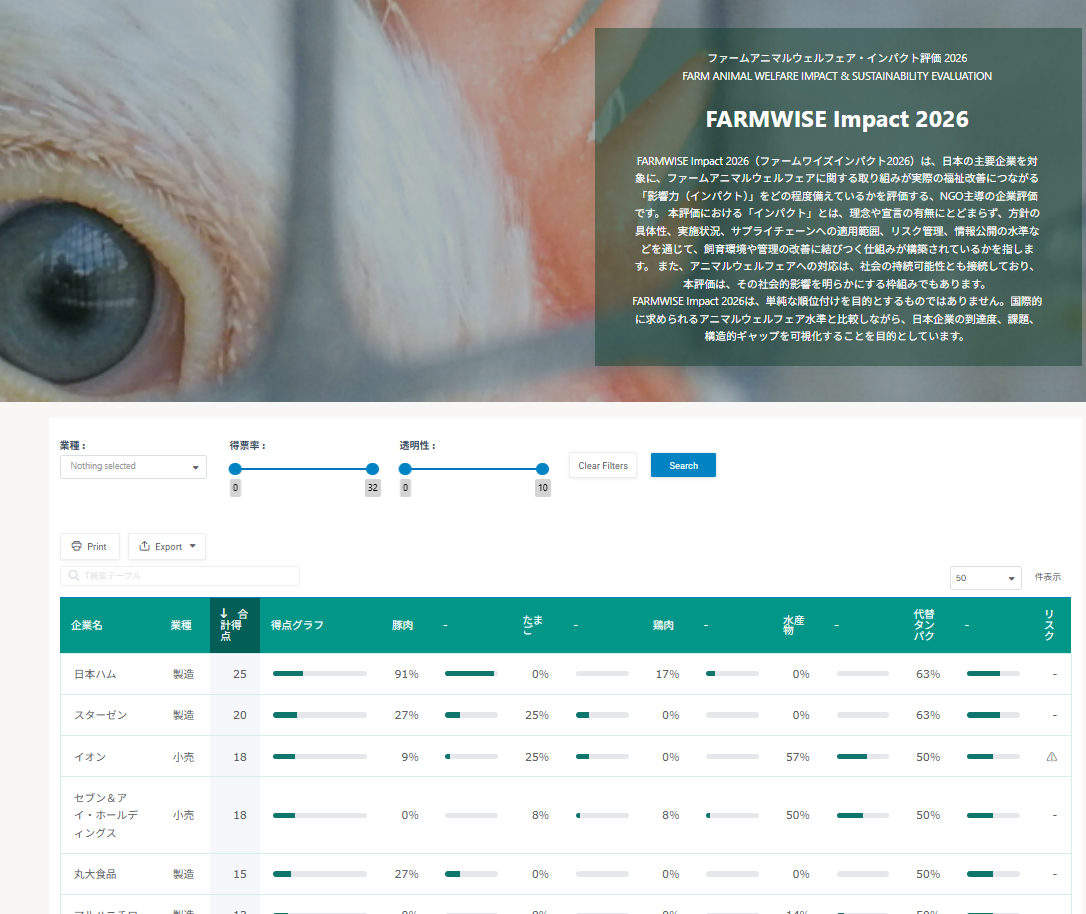
FARMWISE Impact 2026 is an NGO-led corporate assessment of major Japanese companies to evaluate the degree to which their farm animal welfare initiatives have an “impact” on actual welfare improvements. Impact” in this evaluation refers not only to the existence of a philosophy or declaration, but also to the establishment of a system that leads to improvements in the breeding environment and management through the specificity of policies, implementation status, scope of application to the supply chain, risk management, and level of information disclosure. Animal welfare responses are also connected to social sustainability, and this assessment is also a framework for identifying their social impact.
FARMWISE Impact 2026 is not intended to be a simple ranking. It is intended to visualize the achievement, challenges, and structural gaps of Japanese companies in comparison to internationally required animal welfare standards.
method of investigation
We surveyed public information about companies. Public information includes company websites, reports, annual reports, investor relations information, press articles, answers to public questions (e.g., interviews), and product information.
Based on the information published, we can accept offers of correction from companies.
In addition, we have added a survey item that is unique to ARC: whether or not the company is engaged with its stakeholders regarding animal welfare. Along with companies that have publicly announced that they are engaged, we evaluate whether or not they are engaged with the Association.
subject of an investigation
The companies evaluated in FARMWISE Impact 2026 (107 companies) consist mainly of companies involved in the handling or distribution of livestock products, marine products, eggs, and alternative proteins in the Japanese market.
This evaluation is based on a group of companies with high impact from the perspective of promoting changes in corporate behavior in Japan. It is not a random selection for the purpose of statistical representativeness.
Target companies are not fixed, but will be added and reviewed in phases in the future for each sector such as restaurants, retail, hotels, food manufacturing, and trading companies.
About the Animal Rights Center, an authorized NPO
The Animal Rights Center is a certified non-profit organization that aims to realize sustainable livestock farming and food systems through improving the welfare of farm animals. Through ongoing dialogue and research with corporations, we have been working to institutionalize animal welfare as a management issue. While connecting with international trends, we are also pushing for structural changes in Japanese companies.