
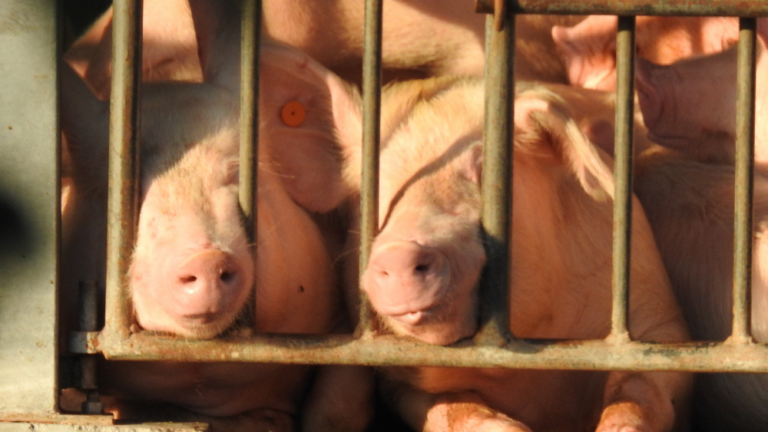
In Japanese slaughterhouses, there is still the problem of pigs and cattle waiting at moorings not being allowed to drink water. In an era when summer temperatures in Hokkaido can exceed 35 degrees Celsius day after day, it seems too much to ask that pigs and cattle be slaughtered without water for several hours to almost 24 hours. It also violates the standards of the World Organization for Animal Health, of which Japan is a member, and may be punishable under the Animal Welfare Law because of its debilitating effect on the animals. It also violates guidelines established 32 years ago by the Ministry of Health, Labor and Welfare.
The Ministry of Health, Labor and Welfare’s Guidelines for Slaughterhouse Facilities and Equipment clearly stipulate this. Although the government states in notices and other documents that installation should be done when new buildings are constructed or renovated, there is no such grace provision in the guidelines.
2 Biological Handling Facilities
The biological handling facility shall have a holding station, a biopsy station, and a quarantine station, and shall have the following requirements
(2) Keijinjo
(iii) ・・・ In addition, drinking water facilities for animals and livestock must be set up.
To solve this problem, following 2023, a survey was conducted in 2025-2026 to determine if pigs and cattle had access to drinking water at all times at the slaughterhouse moorings and were not suffering from thirst in their final days.
The installation rate of drinking water facilities at swine slaughterhouse moorings changed from only 13.6% in 2010-2011 to 40.8% in 2023, 52.8% in 2025-2026, and 64.8% if planned installation is included.
The installation rate of drinking water facilities at cattle slaughterhouse moorings was 49.6% in 2010-2011 and69.3% in 2023, rising to 78.1% in the 2025-2026 survey and 82.5% if planned installation is included.
The fact that the installation rate has exceeded 50%, especially in swine, is an important turning point. It means that we have moved from a situation where “no drinking water facilities are common” for many years to one where at least half of all facilities have drinking water facilities.
Fortunately, improvements have been seen over the past two years, and the speed of these improvements has tended to increase. The number of slaughterhouses that responded that they plan to install such facilities in the future also increased, and the reasons given for this are the extreme heat of summer, which can be described as abnormal weather, as well as an increase in society’s awareness of animal welfare.
Slaughterhouses that have been installed or are scheduled to be installed in the near future also talked about their approach to animal welfare and the cases in which animals were debilitated or died due to the heat, and we could sense their strong desire for improvement.
Slaughterhouses that do not currently have drinking water facilities cannot say now that they will install drinking water facilities in the future because of the difficult business situation. However, since we received your call today, we would like to discuss this issue in the future. Let’s be positive in our approach to discussing this for the animals’ sake. Some slaughterhouses responded positively. In many cases, the reason was business hardship, and we heard requests such as, “I hope we can get subsidies for such things….
This situation remains inadequate compared to international standards. In the European Union, the Regulation (EC) No 1099/2009 on animal welfare requires that slaughterhouse waiting facilities be designed and maintained so that all animals have access to clean water at all times. This means that drinking water facilities are not optional, but are institutionalized as a design requirement for facilities.
In addition, the World Organization for Animal Health (WOAH/formerly OIE) Terrestrial Animal Health Code also states that the basic animal welfare requirement is to avoid prolonged lack of water supply in the management of livestock at slaughterhouses. In these international standards, drinking water is treated as a basic welfare requirement and installation of facilities is the standard, not the exception.
In comparison, in Japan, although improvements have been made, there is no minimum standard as a system, and the issue is left to each facility to deal with.
Furthermore, this Gendai Business article states, “At another cattle and pig processing plant (processing about 1,000 head per day), the repair staff retrofitted 47 locations, and the cost of the parts was only about 550,000 yen. While the details of the work can make a big difference, the repairs “don’t cost as much as the MHLW stresses,” said Executive Director Takahashi Sturzen.” and it is quite possible to work out the cost with some ingenuity.
On the other hand, what concerns us most are the slaughterhouses that either did not respond or explicitly refused to respond. Some slaughterhouses insisted that they do not need water because they kill animals, saying, “We are not a facility to keep them alive, we are a facility to kill them,” revealing how little they are aware of the guidelines and the Animal Protection Law. In the case of private companies, the answers were given in good faith, but the fact that even public corporations (corporations established with investment from the national and local governments and mainly engaged in business of a public nature) refuse to disclose information related to the treatment of animals, food safety, and hygiene is considered a problem in the way information should be disclosed.
Mr. Okuno, who conducted the 2010-2011 survey, stated, “It is essential for living creatures to have access to free drinking water for as long as they live, not to mention the five freedoms of animal welfare. It is unfortunate that there are still treatment facilities that have not been installed, although the situation is improving in this survey. The survey also found that the situation is improving, but it is still unfortunate that some treatment facilities have not been installed. To read the full comments, click here.
In light of the above, the following policy responses are required
- The installation of drinking water facilities in slaughterhouse standby facilities should be upgraded from a guideline to a stronger standard and made mandatory by law or regulation.
- The government should set a deadline for the installation of facilities that allow for drinking water at all times and strongly encourage the installation of such facilities.
- The government should consider subsidizing at least the cost of materials.
- Strengthen animal welfare auditing and disclosure mechanisms in slaughterhouses
While the results of this survey indicate that animal welfare in Japanese slaughterhouses is steadily improving, the results also make it clear that slaughterhouses continue to delay their response when decisions are left to them, and that institutional strengthening is required.
We must develop a system in line with international standards to ensure that all animals are guaranteed a minimum level of welfare before slaughter.
Results of survey on installation of drinking water facilities in slaughterhouses
Survey period: September 2025-February 2026
Survey method: Questionnaire mailed and telephone interviews
Survey entity: Animal Rights Center, a certified NPO
Pig slaughterhouse
We consider the fact that the installation rate of drinking water facilities for pigs has exceeded 50% as an important turning point. The number of slaughterhouses with drinking water facilities has increased by 15 since 2023, and has improved by 12% over the past two years. However, if the rate of change at the time of the survey is assumed to continue, it is calculated that slaughterhouses without drinking water facilities will exist until 2034. However, the lack of institutional enforcement may prevent slaughterhouses with low awareness (e.g., those that refused to answer or listen at all during this period) from installing drinking water facilities in the foreseeable future.
The number of slaughterhouses that did not respond was 9, indicating a positive change in their attitude toward disclosing information to the public.
| pig | 2026 | 2023 | ||
| number of events (e.g. accidents, crimes, meetings, housing starts, hits on a road) | ratio | number of events (e.g. accidents, crimes, meetings, housing starts, hits on a road) | ratio | |
| Drinking water facilities available | 66 | 52.80% | 51 | 40.80% |
| Scheduled to be installed | 15 | 12.00% | 3 | 2.40% |
| No drinking water facilities | 35 | 28.00% | 41 | 32.80% |
| No answer | 9 | 7.20% | 30 | 24.00% |
| Total number of slaughterhouses | 125 | 125 | ||
| Percentage of installations including planned | 81 | 64.80% | ||
Swine slaughterhouses that do not currently have drinking water facilities but have plans to install them
| Hayarai Meat Distribution Center | Scheduled to be installed | Five-Year Plan |
| Kitami District General Meat Distribution Center | Scheduled to be installed | Five-Year Plan |
| Tokachi General Meat Distribution Center | Scheduled to be installed | Five-Year Plan |
| Hakodate Plant of Hokkaido Livestock Breeding Co. | Scheduled to be installed | Five-Year Plan |
| Kamikawa Plant, Hokkaido Livestock Corporation | Scheduled to be installed | Five-Year Plan |
| Misawa City Meat Processing Center | Scheduled to be installed | Fiscal year 2026 |
| (Ibaraki Prefecture Central Meat Corporation | Scheduled to be installed | Summer 2026 |
| (Gunma Meat Wholesale Market Co. | Scheduled to be installed | Fiscal year 2026 |
| Saitama Meat Market Co. | Scheduled to be installed | FY2028 |
| Kobe Municipal Meat Center | Scheduled to be installed | Equipment is being surveyed. |
| Hiroshima City Slaughterhouse | Scheduled to be installed | In the process of introduction During FY2026 |
| JA Ehime Aipax Co. slaughterhouse | Scheduled to be installed | Fiscal year 2026 |
| Kyushu Kyodo Meat Co. | Scheduled to be installed | 2027-2028 |
| JA Goto Meat Center | Scheduled to be installed | After 2027 |
| Miyakonojo Wellness Meat Co. | Scheduled to be installed | Installed by March 2026 |
Pig slaughterhouses without drinking water facilities
| Kuji Regional Slaughterhouse | No drinking water facilities | |
| Sendai City Meat Plant | No drinking water facilities | |
| Yonezawa City Slaughterhouse | No drinking water facilities | |
| Aizu Meat Center (Aizu Wakamatsu Meat Business Cooperative) | No drinking water facilities | |
| Ryugasaki Meat Center Ryugasaki Meat Business Cooperative | No drinking water facilities | |
| Ibaraki Kyodo Meat Co. | No drinking water facilities | |
| Ibaraki Kyodo Meat Co. | No drinking water facilities | |
| Kenpoku Meat Center | No drinking water facilities | |
| Cooperative Association Honjo Meat Center | No drinking water facilities | |
| Koshigaya Meat Center | No drinking water facilities | |
| Yokoshibahikari Town Toyo Meat Center | No drinking water facilities | |
| Tojo Town Meat Center | No drinking water facilities | |
| Tokyo Metropolitan Shibaura Slaughterhouse | No drinking water facilities | |
| Nagaoka Meat Center | No drinking water facilities | |
| Niigata City Meat Center | No drinking water facilities | |
| Toyama Meat Center Co. | No drinking water facilities | |
| Ishikawa Kanazawa Meat Distribution Center | No drinking water facilities | |
| (Yamanashi Meat Distribution Center Co. | No drinking water facilities | |
| Hokushin Meat Center Co. | No drinking water facilities | |
| Hamamatsu City Meat Local Wholesale Market | No drinking water facilities | |
| Handa Meat Center | No drinking water facilities | |
| Nagoya City Central Wholesale Market Southern Market | No drinking water facilities | |
| Higashimikawa Meat Distribution Center | No drinking water facilities | |
| Toyota Meat Center | No drinking water facilities | |
| Osaka City Slaughterhouse | No drinking water facilities | |
| Shingu Meat Center | No drinking water facilities | |
| Nara Prefectural Meat Center | No drinking water facilities | |
| Naruto Meat Center, Bizan Foods Co. | No drinking water facilities | |
| Kagawa Agricultural Cooperative Higashisan Livestock Breeding Promotion Center, Okawa Livestock Breeding Center | No drinking water facilities | |
| Kitakyushu Municipal Meat Center | No drinking water facilities | |
| (Oita Prefecture Livestock Breeding Public Corporation | No drinking water facilities | |
| Kanoya Plant, JA Meat Kagoshima Co. | No drinking water facilities | |
| Shibushi Livestock Breeding Co. | No drinking water facilities | |
| Okinawa Prefectural Meat Center Co. | No drinking water facilities | |
| Kumejima Slaughterhouse | No drinking water facilities |
Pig slaughterhouses that did not respond or refused to respond
| Hokkaido Chikuren Meat Kitami Meat Center Co. | No answer |
| Miyagi Meat Distribution Center | No answer |
| Kitashika Meat Distribution Center | No answer |
| (Yamagata Meat Corporation | No answer |
| Toride Meat Center | No answer |
| Takasaki Meat Center | No answer |
| Wako Meat Center | No answer |
| (Matsumoto Branch Office, Nagano Prefectural Meat Corporation | No answer |
| Saga Prefecture High Performance Meat Center KAKEHASHI | No answer |
Cattle slaughterhouse
The remaining 21.93% of cattle slaughterhouses did not have drinking water facilities, an improvement of 8.77% over the two years. The number of slaughterhouses that did not respond to the survey was 7, indicating a positive change in their attitude toward information disclosure to the public.
| cattle (Bos taurus) | 2026 | 2023 | ||
| number of events (e.g. accidents, crimes, meetings, housing starts, hits on a road) | ratio | number of events (e.g. accidents, crimes, meetings, housing starts, hits on a road) | ratio | |
| Drinking water facilities available | 89 | 78.07% | 79 | 69.30% |
| Scheduled to be installed | 5 | 4.39% | 1 | 0.88% |
| No drinking water facilities | 13 | 11.40% | 13 | 11.40% |
| No answer | 7 | 6.14% | 21 | 18.42% |
| Total number of slaughterhouses | 114 | 114 | ||
| Percentage of installations including planned | 94 | 82.46% | ||
Cattle slaughterhouses that do not currently have drinking water facilities but have plans to install them
| name | Cow Result | Scheduled date |
| Hokkaido Livestock Corporation 1 facility remaining | Scheduled to be installed | Five-Year Plan |
| Kawaguchi Meat Receiving Co. | Scheduled to be installed | Scheduled to be rebuilt |
| Takamatsu City Meat Center | Scheduled to be installed | |
| Shimanto City Meat Center | Scheduled to be installed | |
| Kyushu Kyodo Meat Co. | Scheduled to be installed | 2027, 10th year |
Cattle slaughterhouses without drinking water facilities
| Meihoku Meat Corporation Hakodate Plant | No drinking water facilities |
| Yokoshibahikari Town Toyo Meat Center | No drinking water facilities |
| Nagaoka Meat Center | No drinking water facilities |
| Niigata City Meat Center | No drinking water facilities |
| Hamamatsu City Meat Local Wholesale Market | No drinking water facilities |
| Handa Meat Center | No drinking water facilities |
| Osaka City Slaughterhouse | No drinking water facilities |
| Awaji Meat Center | No drinking water facilities |
| Fukuyama City Meat Center | No drinking water facilities |
| Kitakyushu Municipal Meat Center | No drinking water facilities |
| Kanoya Plant, JA Meat Kagoshima Co. | No drinking water facilities |
| Shibushi Livestock Breeding Co. | No drinking water facilities |
| Kumejima Slaughterhouse | No drinking water facilities |
Cattle slaughterhouses that did not respond or refused to respond
| Hokkaido Chikuren Meat Kitami Meat Center Co. | No answer |
| Kitashika Meat Distribution Center | No answer |
| (Yamagata Meat Corporation | No answer |
| Takasaki Meat Center | No answer |
| Wako Meat Center | No answer |
| (Matsumoto Branch Office, Nagano Prefectural Meat Corporation | No answer |
| Saga Prefecture High Performance Meat Center KAKEHASHI | No answer |