
The FY2025 supplemental budget was approved by the Budget Committee. Included in this budget was an important one for animal welfare.
Loss of consciousness due to gas during chicken slaughter
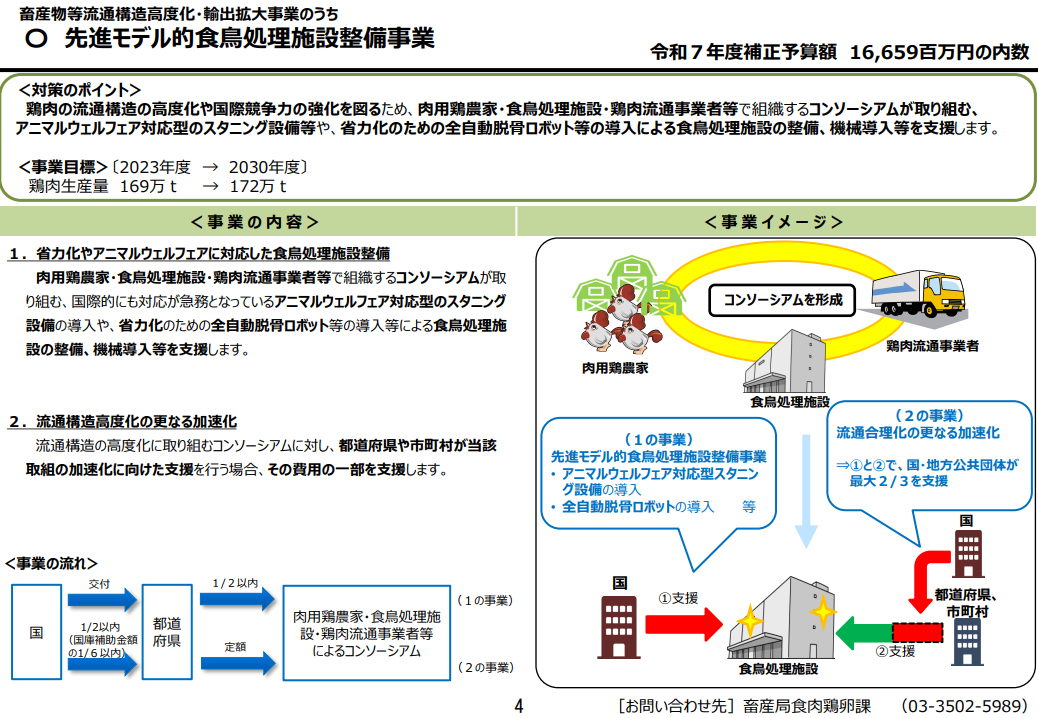
A new quota has been established to subsidize “animal welfare stanning facilities” or “Controlled Atmosphere Stunning” (CAS) for poultry in order to upgrade the distribution structure and strengthen the international competitiveness of poultry products.
The “Advanced Model Poultry Slaughtering Facility Development Project” has been newly established as part of the Livestock Products Distribution Structure Upgrading and Export Expansion Project, and will provide support for the development and introduction of stanning equipment and other opportunities for animal welfare. The subsidy will cover half of the equipment to be installed.
In the past, it was possible to subsidize poultry slaughterhouses through the “Support for the Development of Facilities for the Rationalization of Livestock and Meat Distribution,” which is part of the Comprehensive Support Grant for Building a Strong Agriculture, but in this case, the objective was to enhance profitability, and efficiency and productivity improvements were required, and the value of animal welfare itself was not recognized. In addition, many poultry slaughterhouses were difficult to use. In particular, adult poultry slaughterhouses that slaughter egg-laying hens were not in a position to be involved in increasing meat production itself, and this concept of profitability enhancement and efficiency was a barrier.
The new subsidized project also recognizes the value of animal welfare well.
The fact that the government is aware of the issue of the lack of awareness can be read from the expression “the introduction of animal welfare-compliant stanning facilities, which are urgently needed internationally.
The voices of many people began to reach the country.
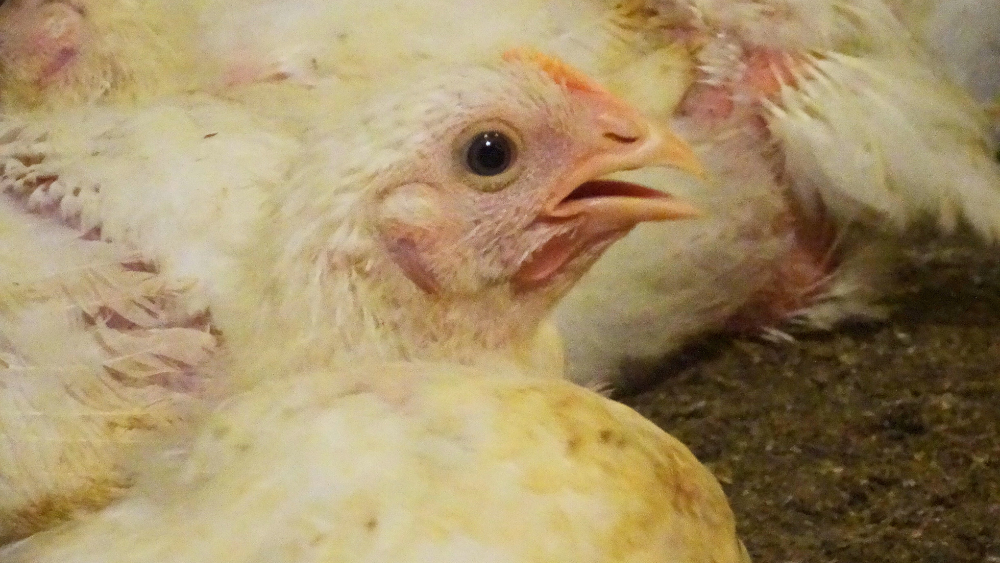
The loss of consciousness before the slaughter of chickens and ducks is something that is mandatory all over the world. In Japan, where it has been taboo to even talk about slaughter itself, the treatment of animals in slaughterhouses has been left behind, a state of affairs that is more than 70 years ahead of the rest of the world. Amidst the anomaly of no one speaking out, the Animal Rights Center continued to address this issue. In particular, there have been many failures in Japanese slaughterhouses that do not use loss of consciousness, and accidents continue to occur in which animals are killed by boiling in boiling water while still alive because they have not lost enough blood. The number of failures continued to increase, and the number of birds killed by boiling finally reached 700,280 (in 2023).
The method that has been widely adopted is to put the head of a chicken suspended upside down in an electrified water tank and make it lose consciousness by electrocuting it. However, interviews with several poultry slaughterhouses have revealed that this method often fails. The voltage level needs to be constantly adjusted, and sometimes the chickens frantically lift their heads as they pass over the electric water tank. Especially in adult poultry slaughterhouses, where chickens of various sizes are brought in, it seemed difficult to adjust the voltage.
Around the world, the use of carbon dioxide, nitrogen, and argon to induce unconsciousness before hanging upside down (CAS) is being introduced one after another to make it easier for the chickens. Japan should move quickly to introduce CAS, rather than reduce the use of the more unsuccessful method of electric stunning. We have been strongly and individually asking for their willingness to adopt gas stanning, starting with a phone survey in 2017, followed by a discussion in 2019 with a survey, and again in 2022. Many of the poultry slaughterhouses we spoke with were positive about gasstanning, noting the renewed awareness and the fact that it is for animal welfare as well as improving labor.
The number of bloodletting failures at the 29 slaughterhouses that responded to the discussions had been steadily decreasing, but the number of failures at the slaughterhouses that did not respond to the discussions (about 100) increased each year by more than that decrease. When the number of chickens boiled to death exceeded 700,000, the Animal Rights Center stepped up its protests. Many citizens have also made their voices heard in the form of comments and petitions.
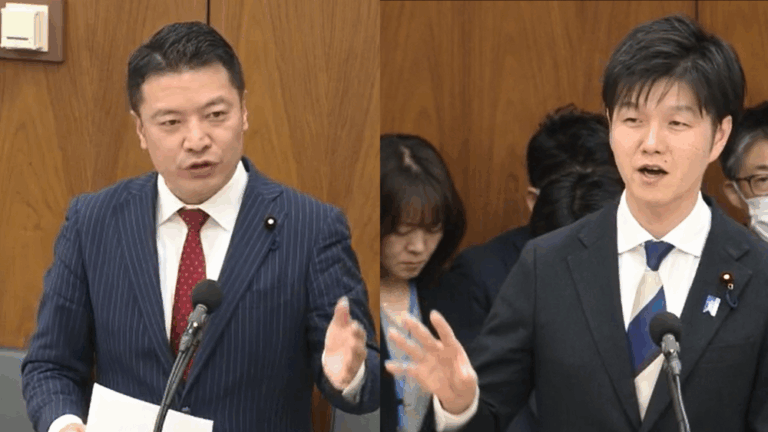
Among the many councilors who asked for help, Councilors Mitsuko Numazaki, Katsuhiko Yamada, Kenko Matsuki, and Shin Miyagawa strongly urged improvements to the Ministry of Agriculture, Forestry and Fisheries, the Ministry of Health, Labor and Welfare, and the Ministry of the Environment.
Against this backdrop, the Ministry of Agriculture, Forestry, and Fisheries (MAFF) has stepped forward.
Now it is the turn of the poultry slaughterhouses to do their best. I hope that they will reach the result of reducing the suffering of the animals as soon as possible.
*Including very small-scale poultry slaughterhouses, the number exceeds 2,000.