

ARC Project Team | Newspaper Team Initiatives
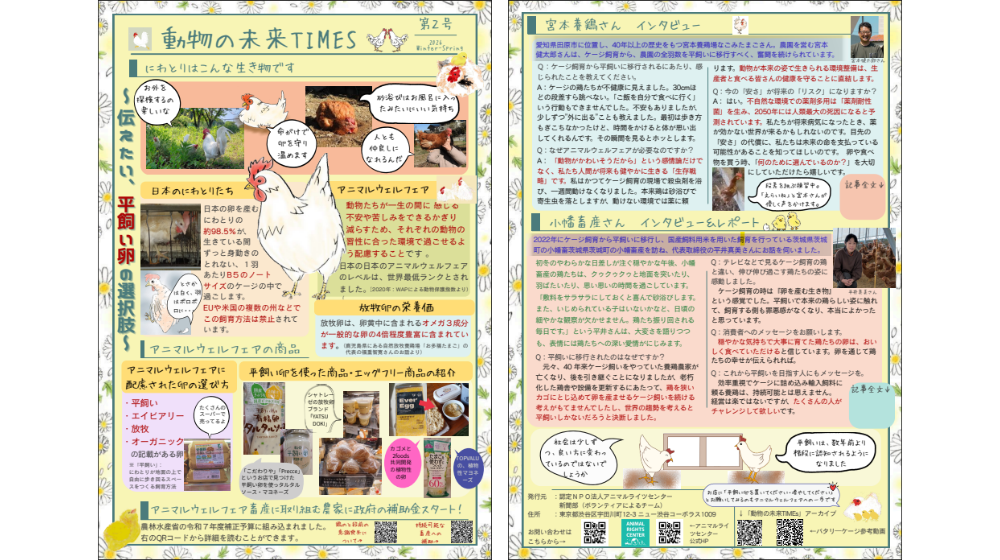
Compared with Issue 1, Issue 2 marked significant progress both in content and in the results of our placement requests.
In terms of content, following Issue 1’s interviews with restaurants, Issue 2 featured interviews with two egg farmers. By having them speak from the producers’ perspective about the differences between battery-cage systems and cage-free systems, we were able to communicate the importance of animal welfare from a broader range of viewpoints.
The Newspaper Team is also putting strong effort into placement requests. In terms of the number of facilities that agreed to place the paper, we distributed 6,665 copies to 87 facilities for Issue 1; for Issue 2, we further strengthened our efforts and significantly increased distribution to 13,055 copies at 187 facilities. Notably, we were able to distribute 6,567 copies to 113 agricultural high schools that have livestock or food-related departments. Of these, six schools told us they would use it as teaching material in class. We were also able to distribute 5,810 copies to 59 educational institutions other than agricultural high schools (elementary schools, junior high schools, high schools, vocational schools, universities, etc.). Schools have supported us in various ways, including handing copies directly to students (pupils and students), posting them in classrooms, and placing them where they can be freely picked up on campus.
In addition, a wide range of facilities—including restaurants, libraries, animal hospitals, and roadside stations—also agreed to place the paper.
We would like to share some memorable comments from teachers when we requested placement at agricultural high schools.
“We don’t have a livestock department, but in our Environmental Science Department we have a unit called ‘Biological Applications / Social animals—learning about animal welfare and the keeping of therapy dogs and other animals used for welfare purposes.’ Chickens are also covered there, and since this issue of the newspaper introduced chickens in detail, we thought we would make use of it,” they said.
Meanwhile, an assistant principal at another high school said, looking very apologetic, “Our school’s chicken coop uses cages, and we teach conventional livestock farming, so there would be discrepancies with what is written in the newspaper and we cannot distribute it. However, it was very educational for all of our staff.” Although we were unable to distribute it there, we were truly pleased to feel that the information is certainly spreading among teachers who teach livestock farming.
“Animal Future TIMES” not only delivers the latest information on animal welfare, but also reaches educational institutions and other audiences that have traditionally been difficult to engage, thanks to its approachable layout. In addition, having secured the cooperation of producers in creating Issue 2 is of great significance. Going forward, we will not limit ourselves to initiatives by the Newspaper Team alone; activists, producers, educational institutions, and others will work together to promote livestock farming that takes animal welfare into account.