
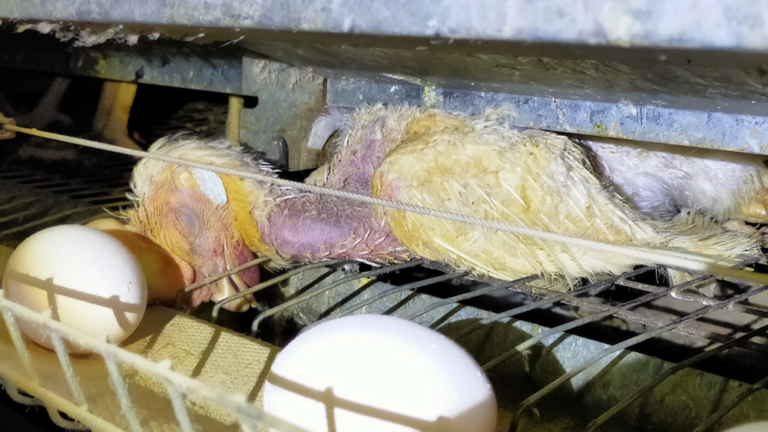
― Inside the Cage Revealed Inescapable Injury
In Japan, the Ministry of Agriculture, Forestry and Fisheries, egg-laying poultry producers, and some researchers have long explained that “feather pecking and cannibalism occur in free-range systems, and cage housing has aspects that better protect ‘freedom from disease and injury.'”
However, this explanation is fundamentally flawed.
First, feather pecking and cannibalism occur in cages as well, within each individual cage. Second, cages provide no space whatsoever for weak birds to escape. Third, in free-range systems there is room to reduce feather pecking through environmental and management improvements, whereas conventional cages offer no such opportunity for improvement.
If one considers why beak trimming (debeaking) is performed, this should have been obvious to everyone from the start. Yet the government and producers have consistently misled the public by speaking as though pecking occurs only in free-range systems.
The issue is not “whether feather pecking occurs.” Nor is it about the natural behavior of establishing hierarchy within a flock.
Cages do not prevent injury; they lock weak individuals into situations from which they cannot escape. And there is no room for improvement. This is the real problem.
Hierarchy Forms in Cages Too
Chickens are social animals that form hierarchies within groups. This is not a problem unique to free-range systems. Hierarchies form even within small cages.
Research has shown that dominant and subordinate individuals emerge in furnished cages, with subordinate individuals disadvantaged in resource use and behavior. Shimmura et al. reported differences in behavior, resource utilization, and physical condition between dominant and subordinate hens in furnished cages.
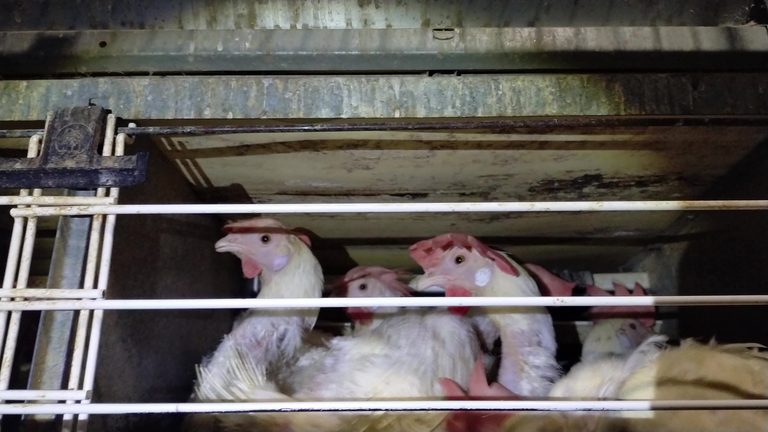
If one bird becomes the lowest-ranking individual in a six-bird cage, approximately 17% of the cage population becomes a persistent subordinate. If two birds are subordinate, the figure is approximately 33%. This is a hypothesis and cannot be immediately generalized to all cages. However, it is clear that in cages where birds live in fixed small groups of 5–8 individuals, subordinate birds are placed in a structure from which they cannot escape the same aggressors.
“Inescapable Bullying” Observed in Inside the Cage
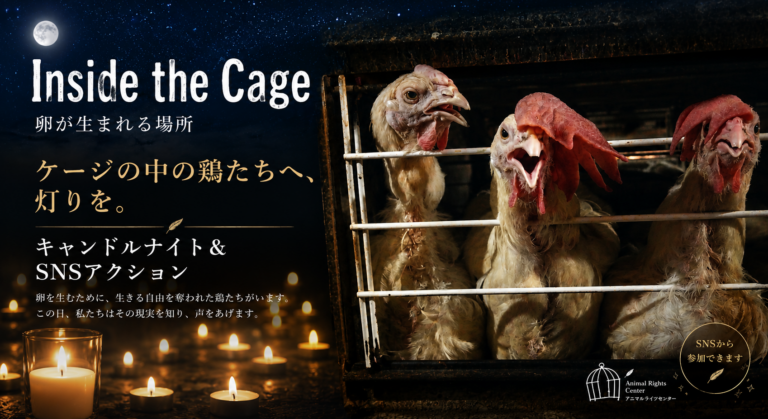
Inside the Cage is a campaign that began in February 2026, conducting daily observations at Japanese egg-laying chicken farms.
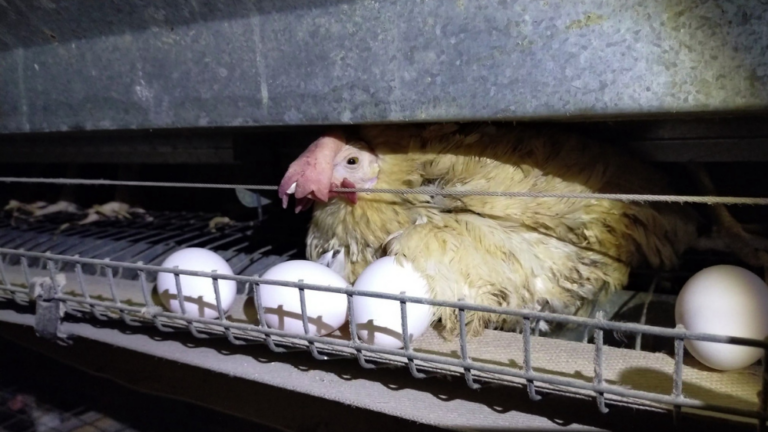
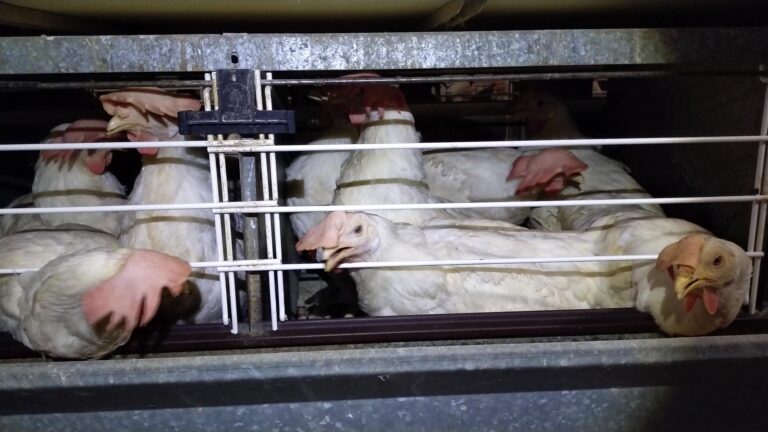
What was revealed was the reality that hierarchies exist within cages, and weak birds are repeatedly cornered.
Weak birds were driven into the gaps of the cage.
They were mounted by other birds, and the feathers on their backs fell out.
They crouched, unable even to lift their heads.
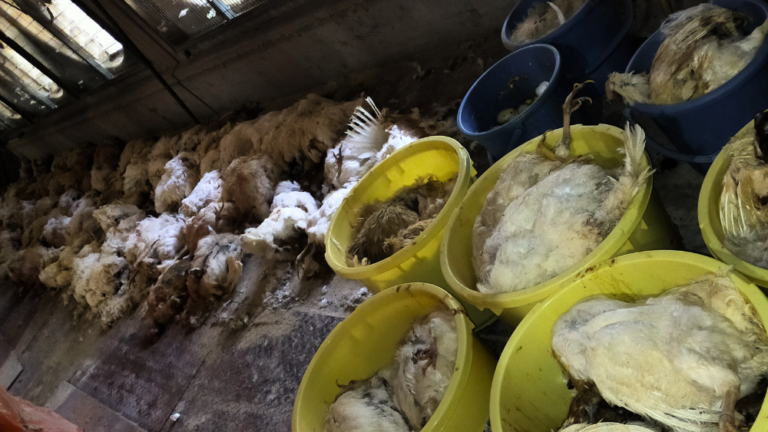
They became trapped in the gaps of the cage, unable to move, weakened, and died.
The report documented that when attempting to free a bird trapped and weakened, it cried out in pain, its skin was in a necrotic state, and even after being removed from the cage, it could not stand. After drinking a little water twice, it dropped its head and closed its eyes.
Additionally, weak birds were trampled in the cage, lost the feathers on their backs, became soiled, could not obtain sufficient feed, and grew smaller. When found, they were moved to “empty cages for isolation,” but there were too many to move them all. If a bird could stand, it was sometimes left behind, as though it had not been seen.
This contradicts the explanation that “cages result in less injury.”
In cages, injury does occur. Moreover, weak birds cannot escape.
Feather Pecking in Free-Range Systems and Fixed Victimization in Cages Are Not the Same
Feather pecking and cannibalism do occur in free-range systems. This is not denied. Free-range systems without countermeasures create serious welfare problems.
However, the occurrence of feather pecking in free-range systems does not mean that cages are superior in terms of welfare.
In a long-term study tracking the same individuals in free-range housing, the following classification of feather pecking behavior in chickens was presented.
- Persistent aggressors: 5.0%
- Persistent victims: 7.9%
- Both aggressors and victims: 29.4%
- Neutral: 3.9%
- Inconsistent individuals: 53.8%
This study shows that while aggression and victimization in feather pecking may be fixed in some individuals, not all chickens become persistent victims.
This is the critical point when comparing with cages.
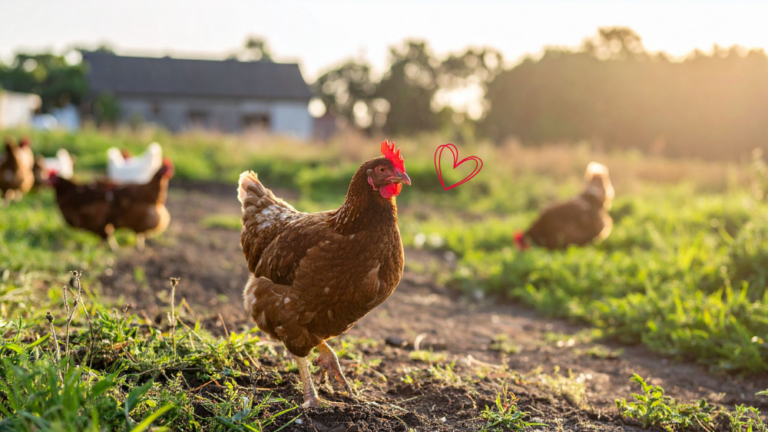
In free-range systems, there is room to move within the flock, maintain distance, and use environmental structures for avoidance. Of course, this requires appropriate management, litter, perches, spaces for refuge, and an environment that satisfies foraging and exploratory behavior.
In conventional cages, this is not possible.
In a fixed group of 5–8 birds, they spend 24 hours a day, for more than a year and a half, with the same individuals. Weak birds cannot leave the group. They cannot hide. They cannot maintain distance. They cannot move to another location.
Ignoring this difference and explaining that “cages protect birds from injury better because feather pecking occurs in free-range systems” is inaccurate both from the perspective of animal behavior science and from the reality on the ground.
Feather Pecking Does Not Occur “Because It Is Free-Range”
Feather pecking is not simply aggressive behavior. It has been treated as abnormal behavior related to the inability to satisfy foraging and exploratory behavior, insufficient environmental stimulation, and inadequate litter.
Rodenburg et al. argue that feather pecking is a serious problem that can lead to injury, cannibalism, and painful death of targeted birds, and that current management relying solely on low light levels and beak trimming is problematic, emphasizing the need for science-based preventive measures.
In other words, what is needed is not “confining chickens in cages.”
What is needed is to create an environment where pecking is less likely to occur, and to ensure space where individuals under attack can escape.
Cages Do Not Achieve “Freedom from Disease and Injury”
What was confirmed in Inside the Cage was feather pecking, mounting, hierarchy, weakness, entrapment, skin damage, necrosis, toe injury, inability to stand, and death within cages.
Weak birds continue to live every day in the same cage with the same individuals. They cannot escape. They cannot distance themselves from aggression. Even when their condition deteriorates, they are trampled and pecked by other birds, and grow weaker still.
Cages do not eliminate injury.
Rather, when injury occurs, they lock weak individuals into situations from which they cannot escape.
The fact that “feather pecking occurs in free-range systems” does not justify cages. Free-range systems have challenges that must be addressed. However, cages lack the very freedom to escape.
If we are to speak of freedom from disease and injury, we must first ensure an environment where injured individuals can escape.
Cages do not meet this minimum requirement.
Conclusion:
Cages do not eliminate feather pecking.
Cages do not eliminate hierarchy.
Cages do not eliminate injury.
What cages do is lock weak individuals into situations from which they cannot escape.
What we saw in Inside the Cage was not “housing with less injury.”
It was the sight of chickens who had lost any place to escape.