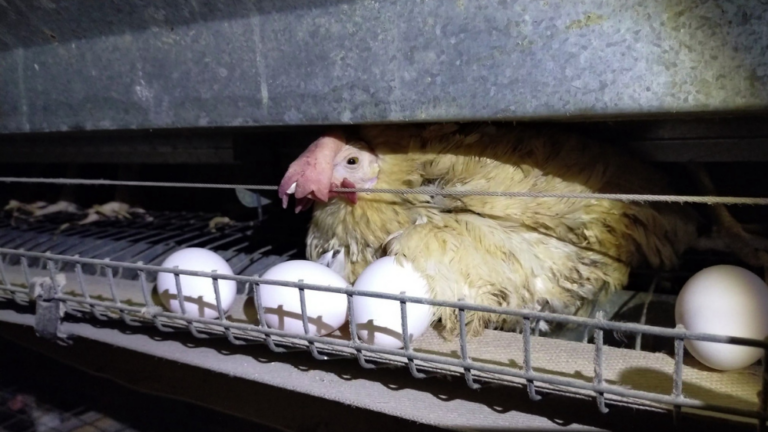

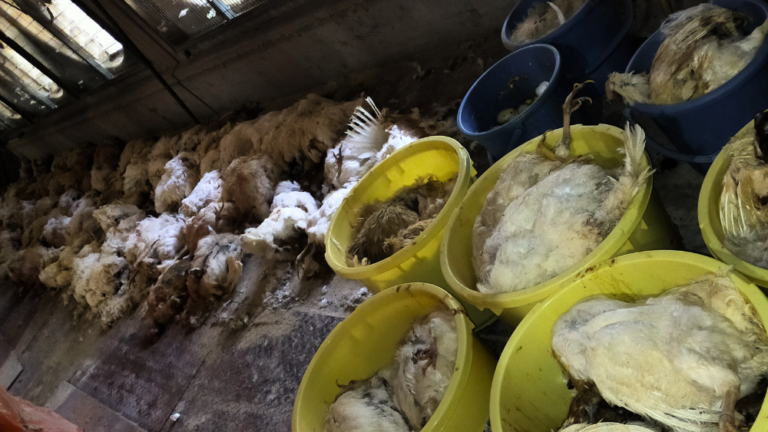
On August 7, 206 carcasses were removed from a single poultry house.
However, this mass death did not occur suddenly.
The chickens began panting with their mouths open in March, and as the heat intensified from spring into summer, their numbers grew. In July, the temperature in the poultry house aisles reached 36°C, and by early August, it hit 37°C.
Furthermore, these values were from thermometers installed in the aisles, not inside the cages where the chickens actually live.
Measurements taken with a thermometer brought in by a whistleblower showed that on some days, the temperature inside the cages was more than 2°C higher than in the aisles.
An Experiment Exposing Chickens to Heat Until Death
There is a terrifying study. In this study conducted in South Korea, chickens housed in battery cages were exposed to an environment of approximately 34°C for up to 280 minutes. The chickens continued intense panting at over 250 breaths per minute, and 60% died.
In another experiment, ventilation systems and fans were turned off, raising the temperature from 26°C to 36°C in one hour. After five hours, over 95% had died, and after five and a half hours, all 24 chickens were dead.
The university’s Animal Care and Use Committee approved this study. However, we do not believe that the act of continuing an experiment while observing chickens die one after another is an acceptable form of research. Since this experiment was conducted in South Korea, Japanese law does not apply directly. However, if a similar experiment were conducted in Japan today, it could potentially constitute abuse under Article 44, Paragraph 2 of the Act on Welfare and Management of Animals, as it involves confining animals in a place that fails to maintain their health and safety, leading to debilitation. The act of causing death would also raise issues regarding “unjustified killing or injuring” under Paragraph 1.
Approval from an ethics review board does not justify making animals suffer until death.
And at the poultry farm featured in Inside the Cage, an environment similar to the one created in this cruel experiment occurred during daily rearing.
Heat Mitigation Reliant Solely on Ventilation
The windowless poultry houses had no cooling equipment like the air conditioners used by humans.
The system exhausts air using large fans at the rear of the house and draws in outside air through cooling pads at the front. During hot periods, water is run over the pads to cool the incoming air.
However, at the site witnessed by the whistleblower, there were many problems with the equipment essential for heat mitigation.
The cooling pads were clogged with years of accumulated dust. Even when cleaned with blowers or brooms, the dust could hardly be removed. It is said that they are not replaced unless they become completely dilapidated.
In Poultry House A, even though chickens were now being kept on the first floor due to renovations, there were no cooling pads at the front of the first floor—only a wall.
In Poultry House B, an egg collection room was installed in a way that blocked the cooling pads that should have faced the outdoors, preventing sufficient intake of outside air.
In Poultry House C, the cooling pads on the south side were broken, making it impossible to run water through them. Consequently, even during hot periods, uncooled hot air entered the poultry house.
Nearly Half of the Ventilation Fans Were Stopped
There were also malfunctions in the ventilation fans at the rear.
The operational status during the height of summer was as follows:
- Poultry House A: 11 out of 12 units
- Poultry House B: 8 out of 14 units
- Poultry House C: 9 out of 16 units
In Poultry Houses B and C, more than 40% of the ventilation fans were not working.
When asked for the reason, it was explained that “they cannot be fixed because parts are not coming in from overseas.” This poultry farm used a housing system from the German company Big Dutchman.
In multi-tier cage houses, even if the ventilation fans are running, temperature and wind speed are not necessarily uniform. Research has pointed out that general negative pressure ventilation suffers from temperature differences and uneven airflow depending on the location.
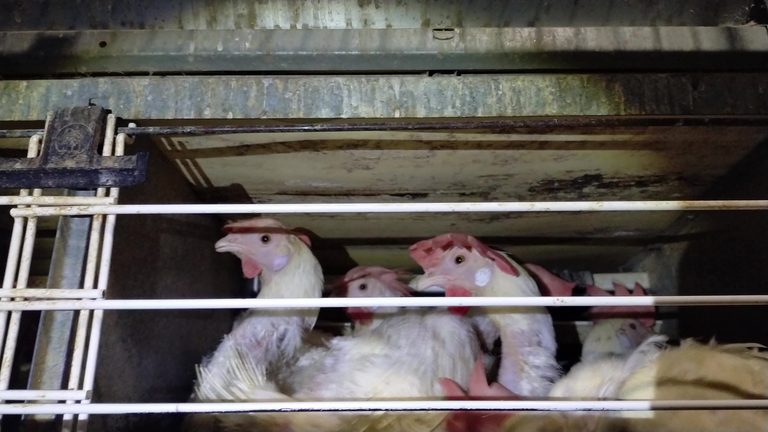
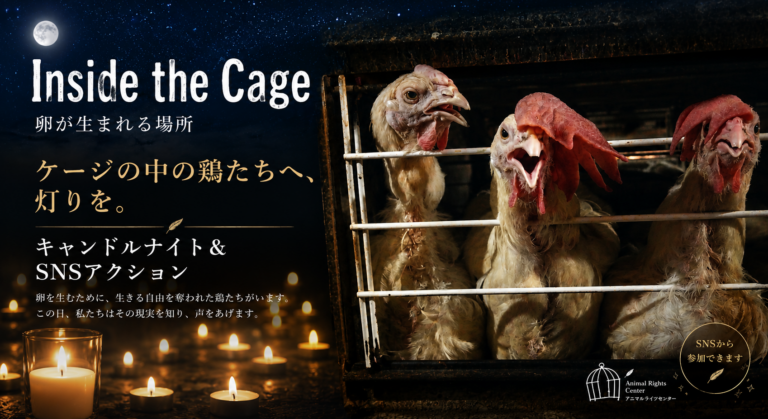
The chickens were all panting, with their heads thrust out of the cages.
This was because the heat in the aisles was slightly more bearable than inside the cages.
However, the chickens can only get their faces out. They cannot move to a place with a breeze, nor can they move their bodies away from other chickens.
“This is nothing to worry about”
On the morning of July 27, while the whistleblower was removing carcasses from cages in Poultry House B, they noticed the number was clearly higher than usual.
They said they realized halfway through, “This is death from heat.”
That day, 76 carcasses were removed from Poultry House B and 67 from Poultry House C.
When speaking with other employees about so many chickens dying, they were told the following:
“This is nothing to worry about.”
“With this much heat, this number of deaths is actually good.”
Chickens dying from the heat was a recurring event every year and was no longer a surprise.
It is said that previously at this farm, a power outage stopped the ventilation fans, causing about 1,000 chickens to die at once. An employee described entering the house to find countless chicken legs protruding from the cages.
When the whistleblower informed the manager that a large number of carcasses had been found and asked what should be done, the answer was: “There’s nothing to be done. We just have to wait and see.”
No Energy Left to Be Wary of Humans
Around 3:30 PM the same day, when the whistleblower entered Poultry House B again, the chickens on both the first and second floors were all panting.
Normally, chickens are wary when a person approaches and will temporarily stop panting.
However, this time, they continued panting even when approached closely.
They were suffering from the heat so much that they didn’t even have the energy to be wary of humans.
One employee said, “When it’s hot, the chickens cry out in a unique voice.”
The whistleblower also heard the chickens making sounds like “gyu, gyu” while panting heavily.
“Aaah, aaah”
“Ah, ah”
They said those voices sounded like they were pleading, “Do something, do something.”
Even So, the Cooling Equipment Was Not Used
During the extreme heat of early August, there were times when water was not being run through the cooling pads on the first floor of Poultry House B.
Because the chickens on the first floor were also panting heavily, the whistleblower suggested to the manager that it might be better to run the water.
However, the response was as follows:
“When they die from the heat, it’s because they get shocked. It’s better not to change the temperature too much.”
The temperature in the poultry house had already reached 36°C at times.
Were they trying to make the chickens get used to this scorching heat without using the cooling pads? The whistleblower could not understand that explanation.
August 7: 206 Died
On August 5, the whistleblower patrolled Poultry House C on behalf of the person in charge.
In this house, water could not be run through the south-side cooling pads. The air coming through the broken pads was a blast of heat.
In the rows near the pads, the air was stifling, and even for a human, it felt difficult to breathe.
Only 9 out of 16 ventilation fans were working.
And two days later, on August 7.
206 carcasses were removed from Poultry House C.
Even from the employees who were accustomed to deaths from heat, voices were raised for the first time saying, “This is abnormal.”
“It’s abnormal for this many to die.”
“Chickens die every year, but even then, it’s usually around 100 or so.”
“Usually, once a lot die, that’s the end of it. There isn’t a second time.”
The 206 did not die simply “because it was a heatwave.”
They died because they were in a rearing environment where they could not escape a single step, no matter how much they suffered.
Inside the Cage: Where Eggs are Born