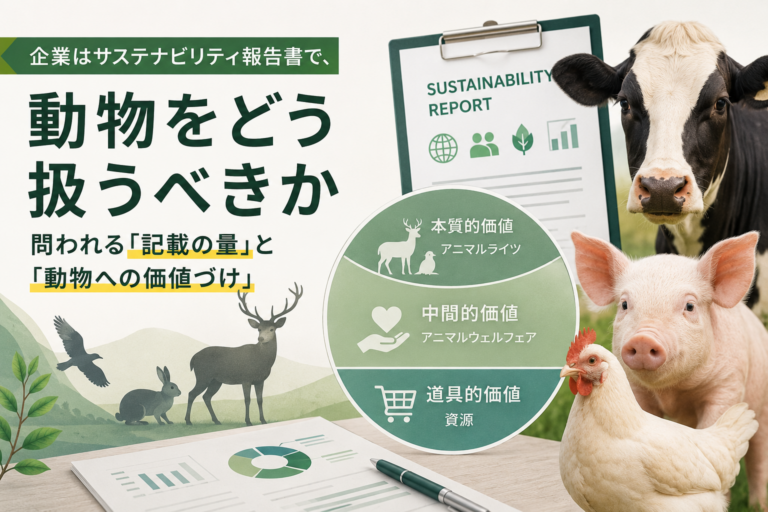


“Dow Jones” is known worldwide. Among its offerings are the “Dow Jones Best-in-Class Indices (formerly the Dow Jones Sustainability Indices/DJSI),” which select index constituents based on corporate sustainability assessments. One of the key assessments used for this selection is S&P Global’s Corporate Sustainability Assessment (CSA).
In the CSA, animal welfare is an official assessment topic for food manufacturers, food retailers, foodservice companies, and others.
What is assessed is quite specific.
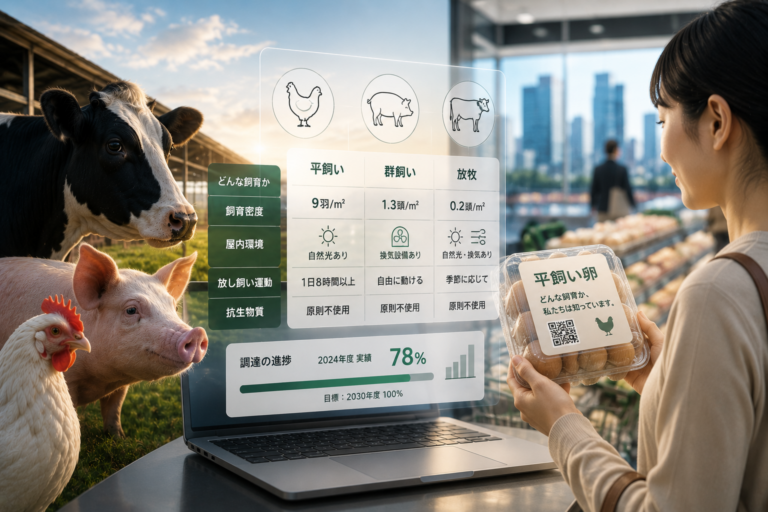
Whether an animal welfare policy is disclosed; whether the policy is applied to suppliers; and whether performance and targets related to animal welfare are disclosed. In addition, within its assessment topics, S&P Global explicitly cites commitments such as cage-free eggs and not using gestation stalls for sows as concrete examples.
First, what is the relationship between Dow Jones and the CSA?
Animal welfare is assessed directly not by the Dow Jones stock index itself, but by S&P Global’s Corporate Sustainability Assessment (CSA). The CSA is a framework that evaluates companies annually from a sustainability perspective, with 62 industry-specific questionnaires. An average of about 1,000 data points per company are assessed, and a final CSA Score from 0 to 100 is calculated.
This CSA Score is also used to select constituents for indices such as the Dow Jones Best-in-Class Indices.
Company initiatives and disclosures
↓
Assessed by the S&P Global CSA
↓
CSA Score
↓
Also used for constituent selection for indices such as the Dow Jones Best-in-Class Indices
That is the relationship.
However, the Dow Jones Best-in-Class Indices do not cover all companies. Because each index has eligibility requirements such as market capitalization, in terms of inclusion in Dow Jones indices, the companies primarily concerned are listed companies above a certain size. Put simply, large listed companies.
That said, the CSA itself covers a broader universe, and in 2026 more than 12,000 companies worldwide are within scope for assessment.
Animal welfare is assessed for food manufacturers, retailers, and foodservice
Three representative food-related industries for which animal welfare questions are set include the following:
- FOA: Food Products (food manufacturers)
- FDR: Food & Staples Retailing (food and staples retail)
- REX: Restaurants & Leisure Facilities (foodservice and leisure facilities)
In the 2026 CSA, questions related to animal welfare are included in the assessment area called “Sustainable Raw Materials.” The weight of this assessment area in the overall CSA score is as follows:
| Industry | Weight of Sustainable Raw Materials | Breakdown of assessment items | AW-related |
|---|---|---|---|
| FOA: Food manufacturers (Food Products) | 5% of the overall CSA score | Sustainable Agriculture Commitment (commitment to sustainable agriculture) | – |
| Certifications of Agricultural Crops (certifications for agricultural crops) | – | ||
| Animal Welfare Policy (animal welfare policy) | Animal welfare policy including the Five Freedoms | ||
| Animal Welfare Disclosure (animal welfare disclosure) | Explicitly states, as concrete examples, a commitment not to use gestation stalls for sows and a commitment to produce only cage-free eggs | ||
| Certifications of Animal Products (certifications of animal products, etc.) | Share of production/procurement certified to animal welfare standards (including seafood) | ||
| FDR: Food and staples retail (Food & Staples Retailing) | 5% of the overall CSA score | Sustainable Agriculture Commitment (commitment to sustainable agriculture) | – |
| Certifications of Agricultural Crops (certifications for agricultural crops) | – | ||
| Certifications of Animal Products (certifications of animal products, etc.) | Share of production/procurement certified to animal welfare standards (including seafood) | ||
| Animal Welfare Policy (animal welfare policy) | Animal welfare policy including the Five Freedoms | ||
| Animal Welfare Disclosure (animal welfare disclosure) | Explicitly states, as concrete examples, a commitment not to use gestation stalls for sows and a commitment to produce only cage-free eggs | ||
| Share of Organic Products (share of organic products) | – | ||
| REX: Foodservice and leisure (Restaurants & Leisure Facilities) | 2% of the overall CSA score | Certifications of Animal Products (certifications of animal products, etc.) | Share of production/procurement certified to animal welfare standards (including seafood) |
| Animal Welfare Policy (animal welfare policy) | Animal welfare policy including the Five Freedoms | ||
| Animal Welfare Disclosure (animal welfare disclosure) | Explicitly states, as concrete examples, a commitment not to use gestation stalls for sows and a commitment to produce only cage-free eggs |
In this way, in the 2026 CSA,
- Food manufacturers (FOA): Sustainable Raw Materials is 5% of the overall score, and 3 of 5 questions are AW-related
- Food retail (FDR): 5% of the overall score, and 3 of 6 questions are AW-related
- Foodservice and leisure (REX): 2% of the overall score, and all 3 questions are AW-related
This is the structure.
However, it is not possible to calculate it as “3 out of 5 questions, so 5% × 3/5 = 3%.” Because S&P Global does not publicly disclose the individual weight of each question, it is not possible to determine what percentage of the overall CSA score is attributable to animal welfare.
Meanwhile, for REX, because all questions that make up “Sustainable Raw Materials,” which accounts for 2% of the overall score, are AW-related, it can be explained that this entire assessment area is composed of animal welfare questions.
It can be confirmed that for food manufacturers and food retail, multiple AW questions exist within an assessment area that accounts for 5% of the overall score, while for foodservice, the assessment area accounting for 2% of the overall score is composed entirely of AW-related questions.
In the foodservice and leisure industry, all “Sustainable Raw Materials” questions are directly related to animal welfare. This indicates that animal welfare is an independent, concrete corporate assessment topic for foodservice companies. However, the three questions are not necessarily weighted equally. Publicly available materials from S&P Global confirm that Sustainable Raw Materials as a whole is 2%, but the detailed weighting of each of the three questions is not disclosed.
What, specifically, is assessed?
1. Animal Welfare Policy — Whether the company has a policy and discloses it
S&P Global asks companies whether they have an animal welfare policy that applies to their own operations and suppliers, and whether they disclose it. It also checks whether the policy includes the Five Freedoms of animal welfare.
In particular, regarding the “freedom to express normal behavior,” S&P Global indicates that necessary elements include “sufficient space, proper facilitiesproviding sufficient space and appropriate facilities,” among others.
This is a “Public” question that requires publicly available information. It is not sufficient for a policy to exist only internally; it must be disclosed as information that can be verified by the public.
2. Animal Welfare Disclosure — Whether specific performance and targets are disclosed
The second is Animal Welfare Disclosure.
Here, companies are assessed on whether they report data and targets related to animal welfare for their own operations and suppliers.
Antibiotics: Whether the company discloses antibiotic use and commits to reducing routine preventive antibiotic use, or requires similar action from suppliers.
Genetically modified and cloned animals: Whether the company discloses a commitment not to use genetically modified or cloned animals, or requires this of suppliers.
Growth promoters: Whether the company discloses a commitment not to use growth-promoting substances such as hormones, or requires this of suppliers.
Audits: Whether the company discloses that it conducts external or internal audits of its animal production facilities at least once every three years, or requires similar disclosure from suppliers.
In addition, data and commitments related to animal welfare are also assessed.
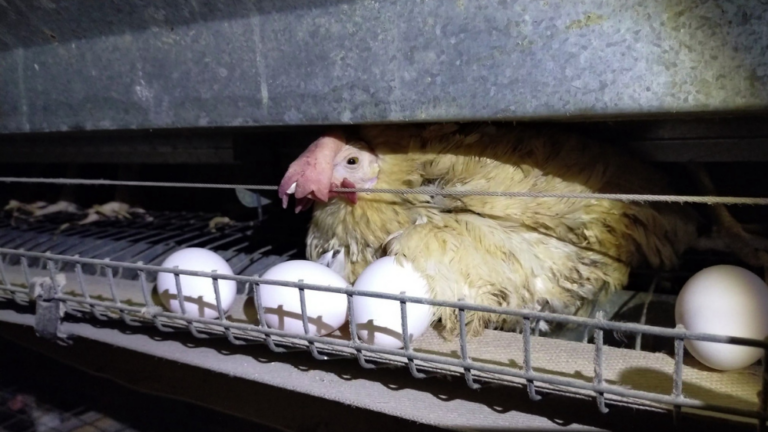
S&P Globa cites “a commitment not to use gestation stalls or a pledge to only produce cage-free eggs.” In other words, a commitment not to use gestation stalls for sows and a commitment to produce only cage-free eggs are explicitly stated as concrete examples of animal welfare disclosure.
3. Certifications of Animal Products — Actual procurement share is also assessed
The third is Certifications of Animal Products.
This assesses not only policies and future targets, but also the livestock products that a company actually produces and procures. S&P Global explains that the purpose of this question is to assess the share of production and procurement certified to animal welfare standards. The scope includes:
- cattle (Bos taurus)
- Dairy products
- pig
- Poultry
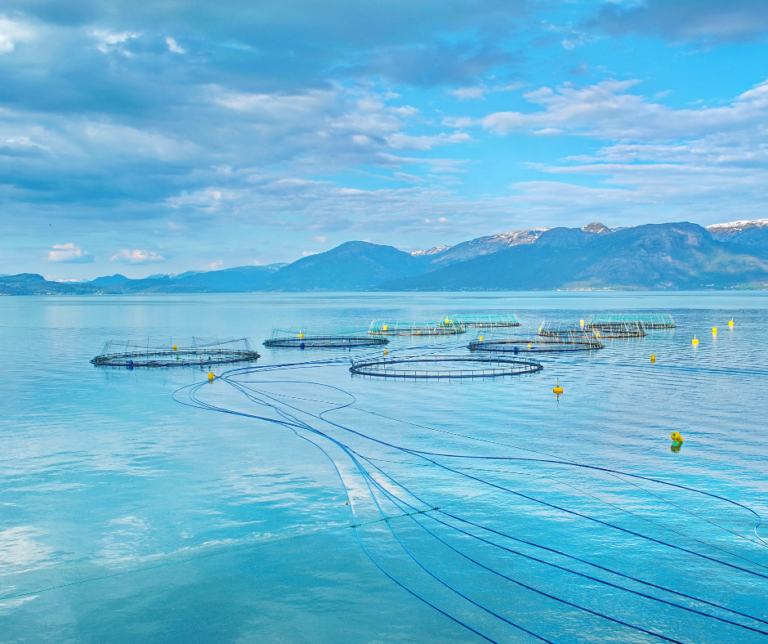
- Farmed seafood
- Wild-caught seafood
and others. Companies must answer questions such as the volume of in-scope livestock products, the certification schemes used, and the share of certified products.
For poultry, S&P Global cites certifications/standards such as Global Animal Partnership (G.A.P.), Certified Humane, Animal Welfare Approved, RSPCA Assured, United Egg Producers, European Chicken Commitment standards, Label Rouge, Red Tractor, and others.
For pigs as well, examples include Global Animal Partnership, Certified Humane, and Animal Welfare Approved.
It is also explicitly stated that additional credit may be given for publicly disclosed information. In other words, the assessment considers not only whether a company “has a policy” on animal welfare, but also the extent to which it actually procures livestock products that meet certain standards.
Disclosure is important
In the CSA, it is important not only what a company is doing, but also whether it discloses it. In particular, Animal Welfare Policy and Animal Welfare Disclosure are questions that require publicly available information. S&P Global explains that for the CSA Score, questions with no disclosure receive a score of zero.
For example, even if a company already uses barn eggs for some products, if it does not disclose that fact or the share, it cannot be verified in assessments that require public information. Similarly, considering a transition to cage-free or the phase-out of gestation stalls internally is different, from a disclosure perspective, from publicly stating them as specific targets.
On the other hand, simply disclosing something does not automatically result in a perfect score. Multiple elements are assessed, including policies, specific targets, audits, responses to antibiotics and other issues, and the share of certified livestock products.
Japanese companies are also in scope
In Japan as well, major companies in food manufacturing, retail, and foodservice are assessed under the CSA.
For example, among companies for which responses to and evaluations under the CSA can be confirmed in S&P Global’s public information are, in the food sector, Meiji Holdings, Ajinomoto, Prima Ham, and Starzen; in retail, Seven & i Holdings; and in foodservice, Skylark Holdings, Yoshinoya Holdings, Royal Holdings, Japan McDonald’s Holdings, and FOOD & LIFE COMPANIES, among others.
Even companies that currently have no CSA response/evaluation may become in scope in the future due to changes in company size or changes to the assessment universe. For major Japanese food manufacturers, food retailers, and restaurant chains, animal welfare is no longer a topic unrelated to international corporate assessments.
Why does S&P Global include animal welfare in corporate assessments?
S&P Global states the reason as follows: “Companies that improve animal welfare may be able to gain or maintain a competitive advantage in the global marketplace.”
“likely to win or retain a competitive advantage in the global marketplace”
- Improved productivity and cost reductions through reduced animal stress, etc.
- Business opportunities driven by the expanding market for animal welfare-certified foods
- Potential to be chosen by retailers and consumers who prioritize animal welfare, food safety, quality, human health, and the environment
And in the actual questions, the following are assessed:
Whether an animal welfare policy is disclosed.
Whether it is applied to suppliers.
Whether specific targets and performance are disclosed.
Whether production facilities are audited.
Whether a commitment to cage-free is disclosed.
Whether a commitment not to use gestation stalls is disclosed.
What percentage of production/procurement volume is certified livestock products.
Such items are assessed. It is also clear that, in Japan, institutional investors are asking food companies specific questions about these items.
Animal welfare is not a topic that only animal protection organizations demand of companies. It is also a set of items that are specifically measured within sustainability assessments that compare major companies worldwide.
Key sources
S&P Global, Corporate Sustainability Assessment (CSA)
S&P Global, 2026 CSA Weights by Industry
S&P Global, CSA Methodology Handbook – Food & Staples Retailing
S&P Global, CSA Methodology Handbook – Food Products
S&P Global, CSA Methodology Handbook – Restaurants & Leisure Facilities
S&P Global, 2026 CSA Sustainable Raw Materials – Certifications of Animal Products
S&P Global, Dow Jones Best-in-Class Indices Annual Review