
Feces Flowing Just Centimeters Overhead—The Unsanitary Reality of Cage Farming Seen in Inside the Cage
For many years in Japan, one of the purported advantages of cage farming has been explained as follows: “It is hygienic because feces fall through the wire mesh floor, separating the chickens from the feces.” This explanation has come not only from the Ministry of Agriculture, Forestry and Fisheries and producers, but also from corporate customer service centers when consumers inquire about cage farming, often receiving responses such as “Cages are hygienic because feces fall below.”
It is true that in battery cages, most of the excreted feces fall through the wire mesh floor to below. As a result, chickens do not continuously walk on litter piled with feces. However, explaining only this aspect as “therefore hygienic” fails to convey what the chickens in actual multi-tier cage systems are actually exposed to.
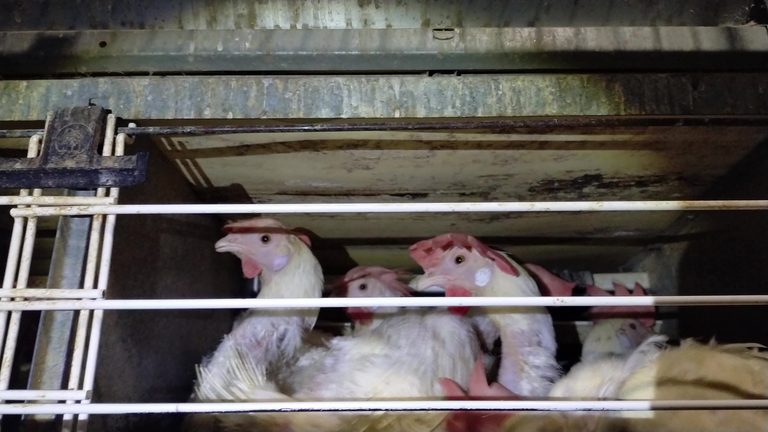
After documenting the interior of a Japanese egg-laying hen farm for approximately nine months in Inside the Cage, what we observed was not “chickens isolated from feces.”
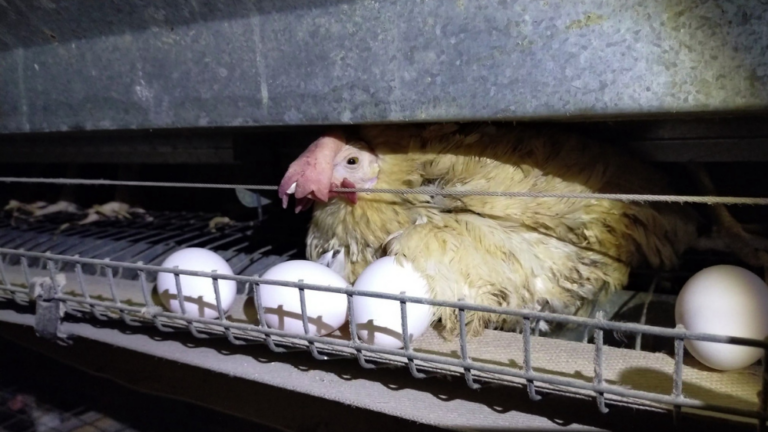
Directly above the heads of the chickens on the lower tier was the manure removal belt that received the feces of the chickens on the upper tier.
There was no separate floor or barrier between the chickens and the manure removal belt.
Feces excreted by chickens on the upper tier were caught directly above the chickens on the lower tier, accumulated there, and periodically transported away by the belt.
During manure removal, large amounts of fecal dust became airborne and rained down on the chickens, feed troughs, and eggs.
When water leaks occurred, wastewater mixed with feces and water fell to the lower tier.
When chickens on the upper tier were injured, blood dripped onto the chickens and feed troughs below.
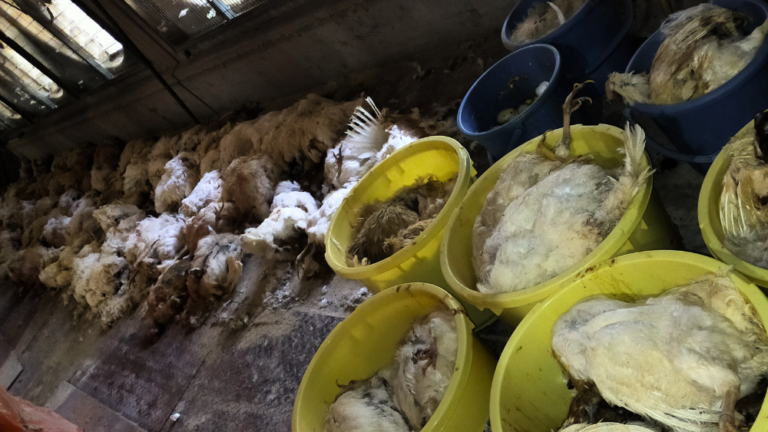
When carcasses decomposed, even their bodily fluids traveled along the manure removal belt and dripped down onto the chickens on the lower tier.
During cleaning, dust and rodent feces were blown by blowers and rained down on the chickens and feed on the lower tier.
“Not stepping on feces” is not the same as “living hygienically.”
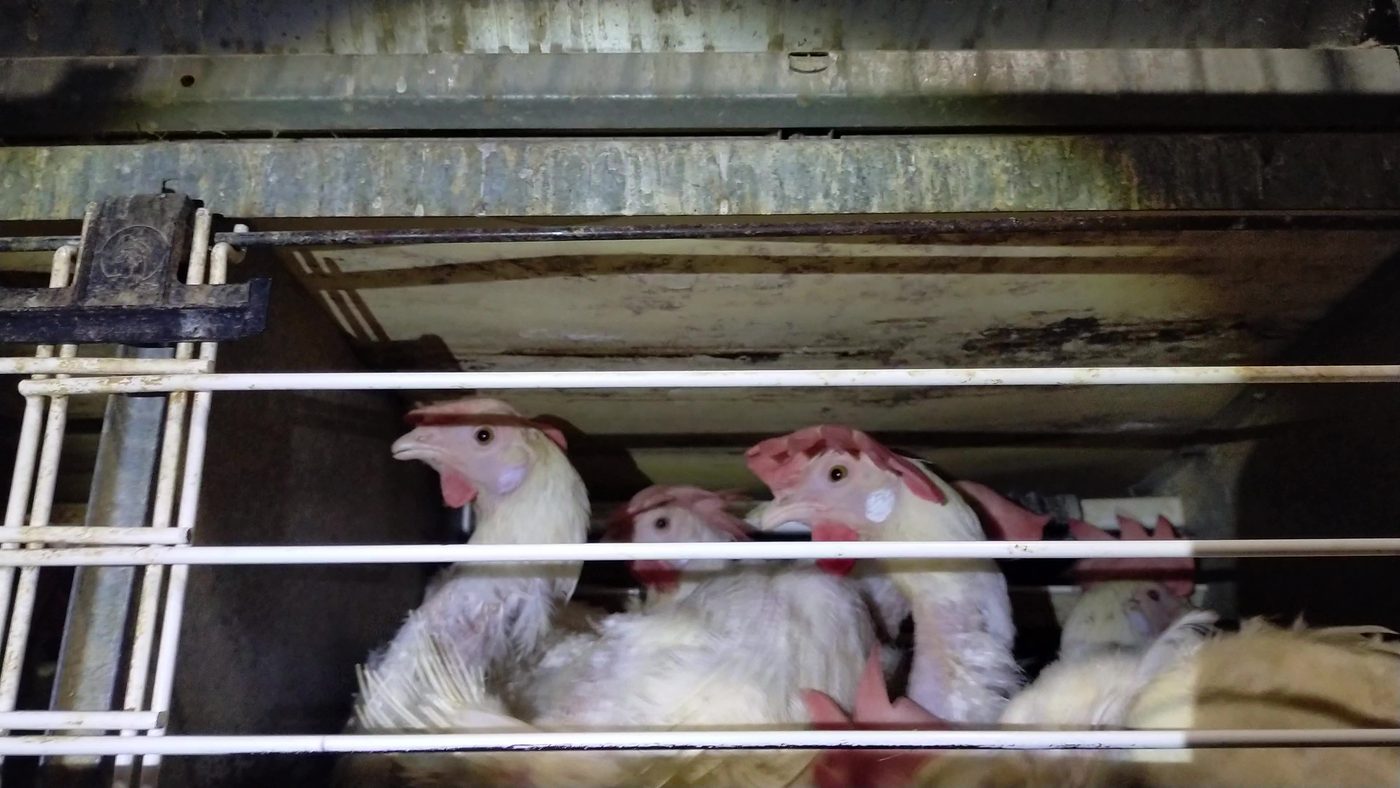
Directly Overhead: Feces from Other Chickens Accumulating
At the farm documented in Inside the Cage, manure belts were installed beneath each tier of stacked cages. Feces excreted by chickens on the upper tier accumulated on those belts, and approximately twice a week, the belts were operated to transport the manure out of the poultry house.
From the perspective of the chickens on the lower tier, this belt is not simply “overhead.”
It is directly above their heads.
In other words, multi-tier cages are not structured to distance upper-tier feces from lower-tier chickens. They are structured so that the residue of upper-tier chicken feces is positioned directly above the heads of lower-tier chickens.
Few consumers hearing only the explanation “In cages, feces and chickens are separated” would imagine this structure.
On Manure Removal Days, Fecal Dust Rained Down on Chickens and Feed
The whistleblower from Inside the Cage documented the conditions on manure removal days as follows:
Manure transported to the rear of the poultry house by the manure belts was carried outside by high-speed conveyor belts. At that time, “the rear of the poultry house was filled with thick clouds of chicken manure dust.”
The dust rained down on both the feed troughs and the eggs.
The odor was so strong that even humans working in the vicinity “could not keep their eyes open,” as documented. The chickens in cages at the rear of the poultry house were exposed to that air every time manure was removed. Testimony from on-site workers also stated, “Chickens often die on manure removal days.”
From this testimony alone, a causal relationship between manure removal operations and mortality cannot be definitively established. However, the fact that large amounts of chicken manure dust became airborne during manure removal and rained down on the chickens, feed, and eggs was confirmed in Inside the Cage.
The explanation “Feces fall onto the belt, so they are separated from the chickens” completely omits this exposure.
Feces-Derived Substances Do Not Remain Only on the Belt
This is not merely a matter of “looking dirty.”
Organic dust in poultry houses contains not only feed, feathers, and skin fragments, but also bacteria, fungi, and feces-derived substances.
One such substance is endotoxin derived from gram-negative bacteria.
In a study by Huneau-Salaün et al. investigating commercial egg-laying hen houses, inhalable dust in cage houses measured 78–576 EU/m³ of endotoxin. Of course, dust also becomes airborne in free-range systems. The study confirmed that some facilities with alternative housing systems such as free-range and aviary had higher concentrations. In other words, cages are not necessarily better; different housing systems present different air hygiene challenges.
What is important to understand here is that “feces falling onto the manure removal belt” and “chickens being isolated from feces-derived substances” are not the same thing.
Even in cage houses, dust containing endotoxin exists in the air. And in Inside the Cage, it was confirmed that this dust actually became airborne during manure removal and rained down on the chickens and feed.
The Fact That It Is “Directly Overhead” Poses a Particularly Serious Challenge
In hygiene science, evaluation focuses not only on whether contaminants “exist,” but also on how much people or animals are actually exposed to them.
What is emphasized in occupational health is the breathing zone—the area around the nose and mouth—measuring how much dust, bacteria, endotoxin, etc., are actually being inhaled.
In a study by Oppliger et al. investigating poultry house workers, measurements in the breathing zone during the task of catching mature chickens showed:
- Inhalable dust: average 26 mg/m³
- Endotoxin: average 6,198 EU/m³
The endotoxin concentration exceeded six times the occupational recommended value in Switzerland at the time. The researchers noted that exposure to high concentrations of dust, bacteria, and endotoxin poses respiratory health problems.
In other words, for humans, we look at “what is flying around the face.” Chickens also breathe through their mouths and noses. For the chickens in Inside the Cage, equipment loaded with feces was positioned directly above their faces. Even when dust became airborne, the chickens could not escape to another location.
“No feces underfoot” alone does not constitute an evaluation of sanitary conditions.
Hospitals Manage “The Air Patients Actually Breathe”
The basic approach is the same in medical facilities.
When airborne microorganisms are present around patients, ventilation, HEPA filters, airflow management, and other measures are used to reduce the concentration of pathogens in the air that patients actually breathe. In other words, what matters is not whether the contamination source is on the floor or ceiling, but what reaches the patient’s breathing zone.
The same must apply to laying hens. If equipment loaded with feces is positioned directly above their heads, and dust from it is falling onto the chickens’ faces, that is an exposure that should be reduced.
Food Factories Prevent “Contamination Falling from Above”
In food hygiene as well, contamination from overhead is an important control target. Contaminated water droplets or substances falling from ceilings, pipes, conveyors, equipment, etc., onto food or food-contact surfaces are prevented as cross-contamination. In other words, food hygiene blocks the vertical pathway:
Contamination source
↓
Food
This vertical pathway is blocked.
However, in multi-tier cages, what is directly below is not only food.It is the heads, faces, and feed of living chickens.The “contamination from above to below” that is naturally avoided in human food hygiene exists as the very structure itself in the living environment of laying hens.
When Water Leaks Occurred, Fecal Wastewater Rained Down from Overhead
In Inside the Cage, water leaks from the water supply equipment occurred repeatedly. Water leaking from the water pipes fell onto the manure belt below that tier.
Feces were there.
Water and feces mixed.
Then, wastewater containing feces rained down on the chickens in the cages below.
The whistleblower documented:
“This happened many times.”
As recorded.
Water leaks occurred from the water pipes on the uppermost tier of the second floor, flowed along the manure belts in succession, and even soiled the chickens on the lowest tier of the first floor with fecal wastewater.
Furthermore, the wastewater also flowed into the feed troughs. Feed and fecal water mixed, turning the inside of the troughs into a muddy mess. By the time it was discovered, automatic feeding had already taken place, and the feed contaminated with wastewater had already been distributed to the chickens.
Water leaks were not discovered immediately. The time spent inspecting one poultry house was less than two hours per day, so several hours—sometimes even tens of hours—had passed since the leak began. During that time, both the chickens and the feed continued to be contaminated.
“Feces and chickens are separated”… This phrase alone cannot explain this situation.
Even Bodily Fluids from Decomposed Carcasses Fell from Above
What was particularly serious in Inside the Cage was the dead chickens.
The whistleblower repeatedly experienced noticing blood-like liquid adhering to the feathers of living chickens, looking up, and finding a half-decomposed carcass in the upper-tier cage.
Bodily fluids from the decomposed carcass traveled along the manure removal belt and dripped down onto the living chickens on the lower tier.
Carcasses themselves were sometimes not collected for extended periods.
When the chickens in a cage were uniformly soiled black, inspection revealed decomposed carcasses or carcasses that had passed through decomposition and dried into black husks.
The whistleblower documented that even when spending as much time as possible on inspections, decomposed carcasses or carcasses that had passed through decomposition and dried were collected almost daily.
This is not merely a matter of discomfort. In poultry biosecurity, dead chickens are handled as potentially carrying pathogens.
The Canadian Food Inspection Agency (CFIA) National Avian On-Farm Biosecurity Standard requires the use of sealed containers when moving dead chickens to prevent feathers, bodily fluids, and other carcass-derived materials from leaking and contaminating surrounding surfaces. This requirement is likely rarely followed in Japan. At every poultry farm, carcasses are carried by hanging them.
It also indicates that carcass storage facilities should be located away from flocks, feed, and water sources.
In other words, not spreading bodily fluids from dead chickens to living chickens or their living environment is a fundamental principle of poultry biosecurity.
What occurred in Inside the Cage was the opposite. Other living chickens were directly below decomposed carcasses, and bodily fluids dripped directly onto them. In summer, when deaths increased, carcasses could not fit in the buckets and were instructed to be lined up on the floor; indeed, in August, carcasses spread across the entire floor.
Blood from Upper-Tier Chickens Also Fell onto Lower Chickens and Feed
It was not only decomposition fluids. In Inside the Cage, it was also confirmed that blood from injured chickens on the upper tier fell onto the chickens, cages, and feed troughs on the lower tier.
Blood is not merely “red dirt.” In infected animals, pathogens may be present in the blood.
For example, Avian leukosis virus subgroup J (ALV-J) causes viremia in laying hens as well. In a study by Gao Y-L et al. infecting laying hens with ALV-J, 15 out of 30 birds—50%—showed persistent viremia over the long term. This study does not demonstrate that lower-tier chickens were infected with ALV-J by blood dripping from the upper tier. However, it does show that infectious pathogens can be present in the blood of infected chickens.
Therefore, a situation in which blood or bodily fluids from other individuals fall directly onto the bodies of living chickens, cages, and feed troughs cannot be considered hygienically acceptable.It is cross-contamination that should be prevented.
When Cleaning Was Done, Even Rodent Feces Flew into the Feed
In Inside the Cage, “cleaning” itself spread contaminants.
Dust was not vacuumed and collected.It was blown away with blowers or swept and scattered with brooms.
When the area around the upper-tier egg collection belt was cleaned, dust fell onto the chickens and feed troughs on the lower tier. When the second-floor walkway was blown with a blower, the blown dust rained down on the chickens and feed troughs on the first floor.
Moreover, there were also rodent feces on the floor. The whistleblower’s report documented:
“Those also flew into the chickens’ feed troughs.”
As recorded. Numerous rodents were present in the poultry house, and rodent carcasses covered in feed even emerged from the feed trough lines. Furthermore, rodents had died and decomposed inside the water receptacles for drinking water.
The single phrase “Cages are hygienic” cannot possibly evaluate the actual sanitary conditions.
The Feed Troughs Themselves Had Accumulated Dirt from an Unknown Number of Years
In Inside the Cage, thick layers of dirt adhered to the feed troughs where chickens ate daily.
When the whistleblower picked up and examined a large lump that had fallen into a feed trough, it was a hardened mass of dirt that had been stuck to the trough and had peeled off. Blackened dirt formed thick layers that extended along the troughs.
However, cleaning the feed troughs was not included in the daily cleaning routine. It was unclear how many years the accumulated dirt had been building up.
Various contaminants—feces, blood, dust, egg liquid, etc.—also adhered to the eggs. Broken eggs mixed with chicken feces adhered to the egg collection equipment, and that dirt then attached to other eggs and flowed downstream. This too is a reality that cannot be explained solely by the equipment feature of “wire mesh floors are hygienic.”
It Cannot Be Said That “Cages Have Less Salmonella”
The simplistic explanation that cages are hygienic and therefore advantageous against infectious diseases also does not hold.
Results vary by study.
Depending on experimental conditions, there are studies in which free-range and aviary systems showed more Salmonella transmission between chickens and egg contamination, but on the other hand, experiments have also been reported in which conventional cages had higher Salmonella Enteritidis organ infection and fecal shedding.
Infectious disease risk is determined by numerous factors, including:
- Whether feces are stepped on
- Stocking density
- Flock size
- Ventilation
- Dust
- Rodents
- Carcass collection
- Cleaning
- Manure removal equipment
- Feed and water management
And many others. Therefore, the explanation “Feces fall through the wire mesh = Cages are hygienic = Disease risk is also low” is not scientific.
And the Question of “Animal Welfare Washing”
Here, another problem arises.
When companies explain to consumers through customer service centers or websites that “In cages, feces and chickens are separated, so it is hygienic,” the following issue emerges.
Looking only at the partial truth that “most feces fall through the wire mesh to below” is not a lie, but if that explanation leads consumers to believe that “Caged chickens live in a clean environment isolated from feces,” then it utterly fails to accurately convey the reality. What was actually confirmed in Inside the Cage was the following reality:
- The manure removal belt receiving upper-tier chicken feces is directly above the heads
- Large amounts of fecal dust become airborne during manure removal
- Dust rains down on chickens, feed, and eggs
- Fecal wastewater flows down to lower-tier chickens
- Fecal wastewater enters feed troughs and contaminates feed
- Blood from upper-tier chickens falls to lower tiers
- Bodily fluids from decomposed carcasses fall to lower tiers
- Carcasses are not collected until they decompose
- Rodent feces are blown into feed troughs
- Contamination of feed troughs and water supply equipment remains
In 2026, researchers articulated the concept of “Animal Welfare Washing (AWW)” as the problem of creating an impression of “animal welfare-conscious production” through corporate or institutional narratives, certifications, and labeling, despite the absence of actual welfare improvements.
In other words, regarding animal welfare as well, the era has arrived when not only “what is being said” but also “whether that explanation corresponds to reality” is being questioned.
In the Environmental Field, “Anti-Washing” Is Already the Rule
In the environmental field, this issue has already become clear. Japan’s Ministry of the Environment revised its “Environmental Labeling Guidelines” in March 2026. The guidelines explicitly state that environmental information must be verifiable, accurate, and not misleading. Furthermore, the scope includes not only product labeling but also:
- Corporate activities
- Image advertising
- Corporate stance
And other forms of expression. The Ministry of the Environment itself has explicitly stated as one of the reasons for this revision that monitoring of greenwashing has intensified in Europe and elsewhere, and that countries are strengthening measures to prevent it.
The EU has gone even further. Directive (EU) 2024/825 legislates a direction to prohibit general environmental claims such as “environmentally friendly” and “green” if they cannot demonstrate corresponding superior environmental performance. The concept is simple:
If you use words that create a positive impression, you must provide evidence for them.
This is not only an environmental issue. If companies explain, “We are considerate of animal welfare,” “Cages have hygienic advantages,” or “Chickens are separated from feces,” then they should be responsible for what consumers imagine based on those words.
Conveying only the partial truth that “feces fall below,” while not explaining that there is a belt loaded with feces directly above the heads, that fecal dust falls during manure removal, that fecal wastewater flows to lower tiers, or that blood and decomposition fluids fall below—if this creates the impression that “cages are hygienic and a good farming method for animals,” then the question must be asked whether this constitutes animal welfare washing. “We explained it because we were ignorant” is not an acceptable excuse.
Now that these facts have been revealed in Inside the Cage, if companies and government agencies continue to repeat the same explanations, they have a responsibility to provide evidence.
If You Call It “Hygienic,” Measure and Demonstrate It
If cages are to be evaluated as “hygienic,” at minimum the following data must be provided:
- Dust concentration in the chickens’ breathing zone during manure removal.
- Bacterial concentration.
- Endotoxin concentration.
- Frequency with which blood, fecal wastewater, and decomposition fluids fall onto lower-tier chickens and feed troughs.
- Time until dead chickens are discovered.
- Frequency of cleaning feed troughs and water supply equipment.
- The extent to which pathogens such as Salmonella are detected in chickens, feces, dust, manure removal equipment, and feed.
Without measuring these, explaining only that “it is hygienic because feces fall through the wire mesh” is not a hygiene evaluation. It is simply an explanation highlighting one feature of the equipment.
To maintain a hygienic environment, it is necessary to clarify what animals are actually exposed to, what disease risks and unpleasant environments they are placed in, and to reduce them. This applies equally to free-range and cage farming.
However, multi-tier cage farming itself—where contamination from above to below occurs structurally and from which chickens cannot escape even one step—cannot be improved.
What we saw in Inside the Cage were chickens unable to escape even one step from a place where the belt receiving the feces of other chickens was directly above their heads, where they inhaled that dust, and where sometimes fecal wastewater, blood, and even bodily fluids from decomposed carcasses rained down. The “hygiene” of cage farming must be evaluated including this reality.
Is “Cages are hygienic because feces are separated” true? The answer is a lie. Companies and government agencies have long told an irreversible lie.