
Repeated Records of “Entrapment” in Inside the Cage
During the nine-month investigation of Inside the Cage, there was a scene repeatedly witnessed:
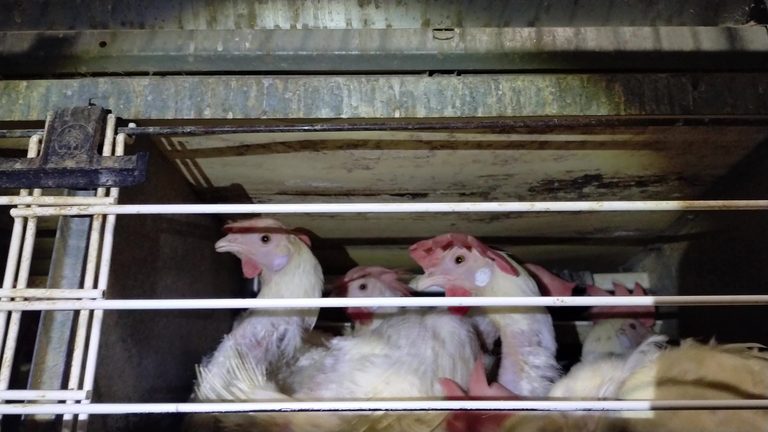
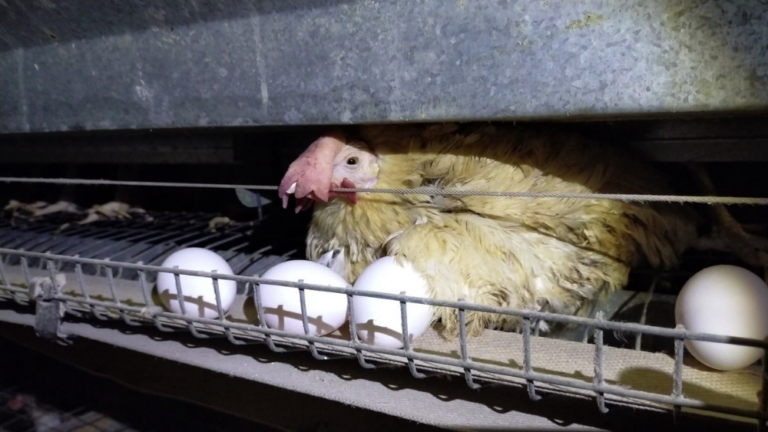
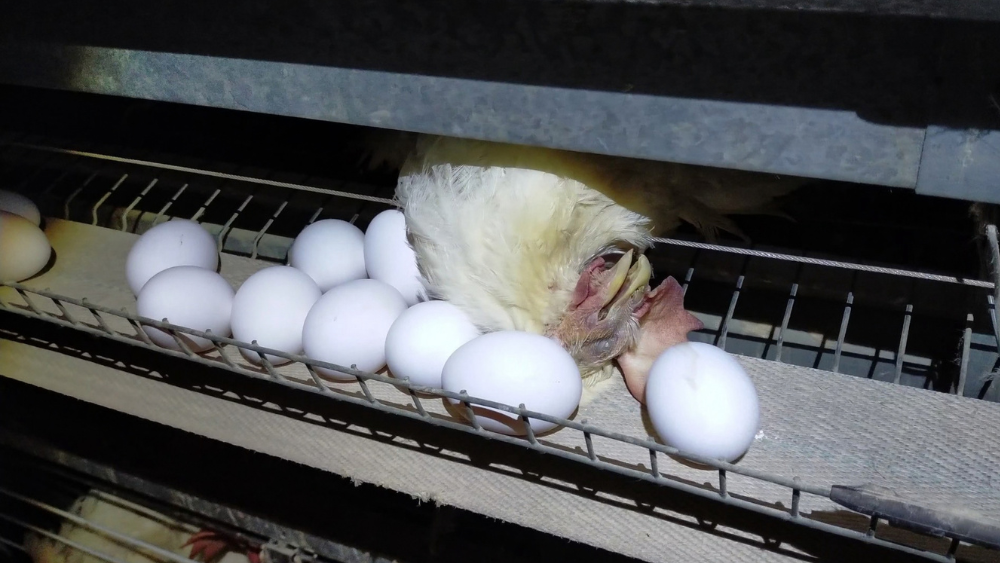
Hens with their bodies trapped in the cage structure, unable to move.
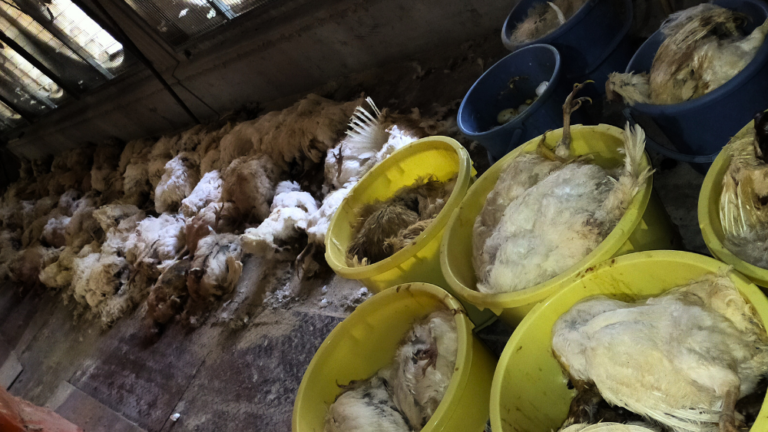
Legs and claws get caught in the wire mesh. Heads and necks become stuck outside the cage, unable to be pulled back in. Wings and bodies become wedged in the cage components, making it impossible for the birds to escape on their own. Some hens were already emaciated when discovered. Many others were found dead while still trapped.
This is not an isolated accident involving a single bird captured by chance in Inside the Cage. The issue of hens being injured or dying due to entrapment in cages has been reported in research for many years.
Once Trapped, There Is No Escape
In the poultry houses investigated by Inside the Cage, multiple hens were housed in a single cage. In some cases, seven hens were placed in a cage that was already overcrowded with six. The hens are surrounded by wire mesh, and the floors are also made of wire mesh. The hens live their entire lives within this environment. Parts of their bodies can slip into gaps and become stuck. In many cases, the birds that get trapped in these gaps are the weaker individuals in the cage or those that have become weakened for some reason.
A trapped hen cannot escape on its own. It becomes unable to change its posture or move to where food and water are located. Unless a human discovers and rescues the bird, it remains in that state.
Inside the Cage actually recorded hens that had become emaciated while trapped, as well as those that had already died.
In many instances, entrapment occurs under the feed troughs or similar locations. In such cases, the trapped bird is trampled by other hens trying to eat or drink, often resulting in the loss of feathers on their backs. This has also been clarified through observations by whistleblowers.
Research Shows Entrapment Accidents in 0.6–3.5% of Hens
The problem of hens getting trapped in cages has been studied for at least several decades.
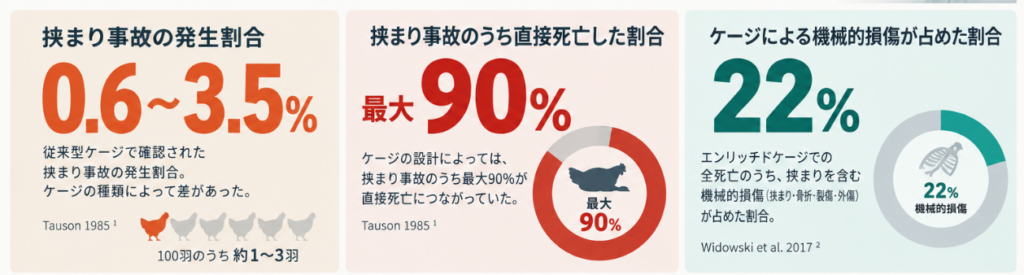
In a study published by Ragnar Tauson in 1985, 3,802 laying hens were raised in six types of cages within the same poultry house to investigate the relationship between cage design and accidents. The results showed that the percentage of hens confirmed to have suffered entrapment accidents ranged from 0.6% to 3.5%, depending on the type of cage.
Furthermore, depending on the cage type, up to 90% of entrapment accidents led directly to death. Of all deaths, including those due to disease, these accidents accounted for 9% to 61%, with an average of 28%.
The locations where accidents occurred were also investigated.
Common occurrences included accidents where heads or necks were trapped at the front of the cage, accidents where toes or claws got caught, and accidents where toes or claws were trapped in the gap between the cage partition and the floor. Research continued thereafter, and 191 accidents were analyzed across seven trials from 1974 to 1984. The study covered a total of 26,364 hens, involving over 40 types of cages from 12 manufacturers. Although accidents decreased due to design changes by manufacturers, even in the final 1983–84 trial, deaths due to accidents accounted for an average of 6% of all mortality. The researchers concluded that even with improved cage designs, producers and cage manufacturers still need to consider this issue.
However, cage designs have not improved. Not only in Inside the Cage but also at other poultry farms, instances of entrapment, feet getting stuck, and heads getting caught in the wire mesh are frequently observed.
Deaths Due to Entrapment Also Confirmed in Enriched Cages
In a study published in Poultry Science in 2017, 1,218 laying hens were raised in cages equipped with perches and nests and monitored until 72 weeks of age. The cumulative mortality rate was 4.6%. Upon investigating the causes of death, 51.2% were related to calcium metabolism or bone-related diseases, 22% were due to mechanical injuries, 9.8% were due to fatty liver, and 17% were due to other causes. The 22% attributed to mechanical injuries included entrapment, fractures, lacerations, and trauma. The researchers specifically cited “trapped hens” as a concrete example of death by mechanical injury.
Entrapment Identified as a Welfare Issue Again in 2023
In 2023, the European Food Safety Authority (EFSA) published a large-scale scientific assessment of the welfare of laying hens. In it, they identified “entrapment of hens” by housing equipment as a cause of injury to the birds’ soft tissues and skin. As a countermeasure, EFSA recommends that housing equipment be designed to prevent the entrapment of hens’ toes, wings, combs, and other body parts.
Even in the 2023 scientific assessment, it is treated as a welfare hazard in current laying hen housing equipment.
The Problem with Cages Is Not Just the Lack of Space
The small amount of floor space per bird is a well-known problem with cage farming. Japan, in particular, has less space than other countries.
However, the reality recorded in Inside the Cage is not just about the lack of space.
The very space where the hens live is enclosed by metal equipment. Even if a part of their body enters the structure and becomes stuck, the hen cannot escape to another location. Entrapment cannot be treated simply as an accidental occurrence for an individual bird.
Furthermore, Inside the Cage repeatedly recorded hens actually being trapped in Japanese egg-laying poultry farms day after day.
The Hen Remains There Until Someone Finds Her
No alarm sounds when a hen gets trapped in a cage.
The hen herself cannot leave the cage to seek help.
In a poultry house containing tens of thousands of birds, a human must discover the abnormality and rescue the bird.
If not discovered, the hen is left behind where she is trapped.
During the Inside the Cage investigation, we continued to observe the hens in the cages almost every day.
Hens crammed into narrow cages. Hens trapped and unable to move. Emaciated hens. Hens already dead.
Even after leaving the poultry house and going to sleep, the investigators began to see hens suffering while trapped in narrow cages in their dreams. It was a scene they had repeatedly witnessed in the actual poultry houses.
If one looks only at a single bird that died after being trapped, it might be called an “accident.” However, the phenomenon of hens being injured or dying due to entrapment in cages has been confirmed by research for decades, is pointed out as a welfare issue in current scientific assessments, and was repeatedly recorded in Inside the Cage.
There are hens that get trapped in cages.
And those that cannot escape have no choice but to endure there until they are discovered by a human.
This is another part of the reality faced by the hens that lay eggs in Japan.
References and Materials
Tauson, R. (1985). Mortality in laying hens caused by differences in cage design.
https://www.periodicos.capes.gov.br/index.php/acervo/buscador.html?id=W2014073255&task=detalhes
Widowski, T. M. et al. (2017). Laying hen welfare I: Social environment and space. Poultry Science, 96(11).
https://academic.oup.com/ps/article/96/11/3805/4055771
Widowski et al. 2017 (Full text, PMC)
https://pmc.ncbi.nlm.nih.gov/articles/PMC5850468/
EFSA Panel on Animal Health and Welfare (2023). Welfare of laying hens on farm. EFSA Journal, 21(2), 7789.
https://efsa.onlinelibrary.wiley.com/doi/full/10.2903/j.efsa.2023.7789
EFSA Paper DOI
https://doi.org/10.2903/j.efsa.2023.7789