
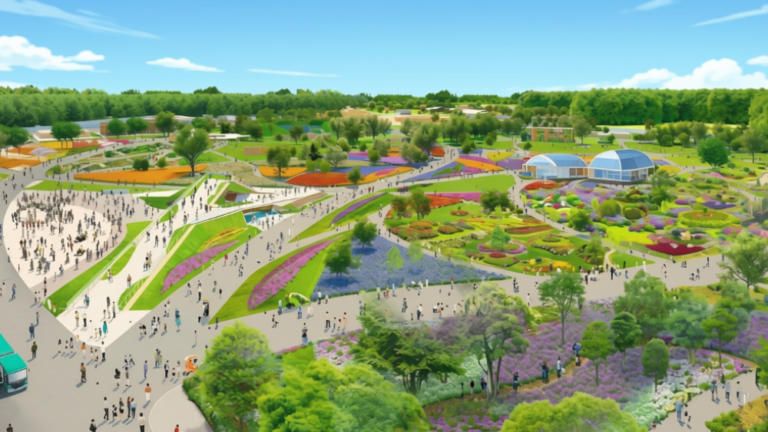
GREEN×EXPO 2027, the International Horticultural Expo to be held in Yokohama in 2027, has published procurement standards for livestock products. However, its animal welfare standards have seen virtually no progress since the Tokyo Olympic and Paralympic Games held in 2021.
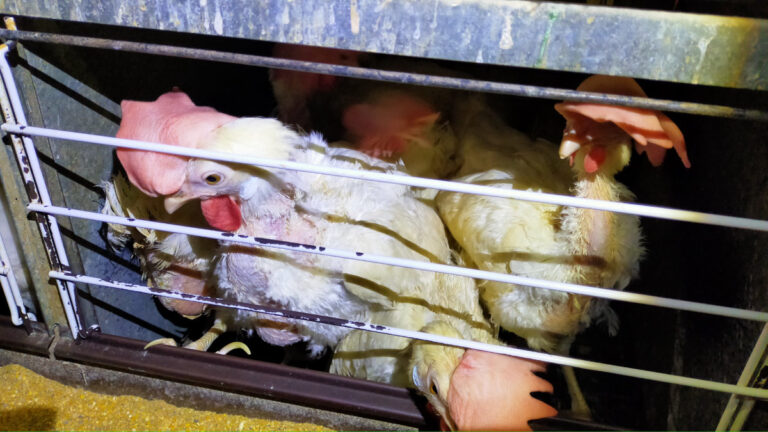
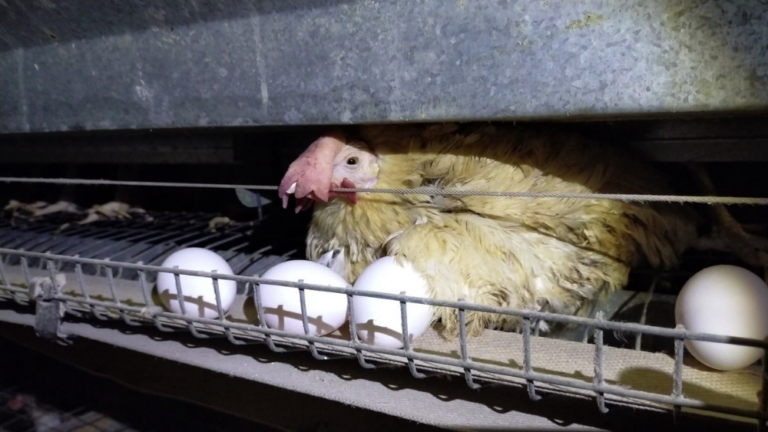
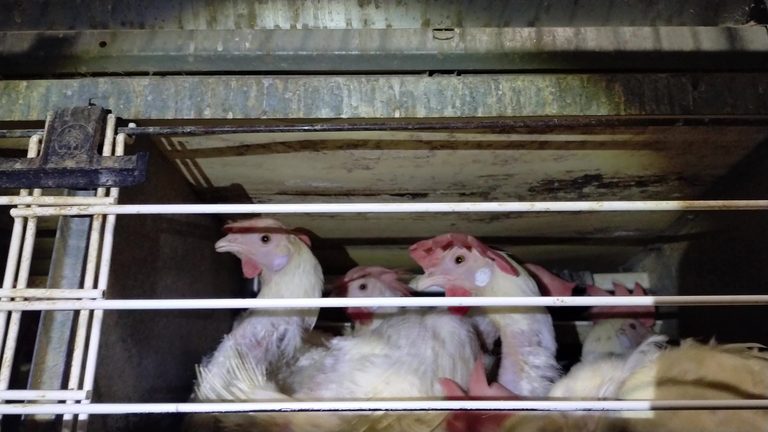
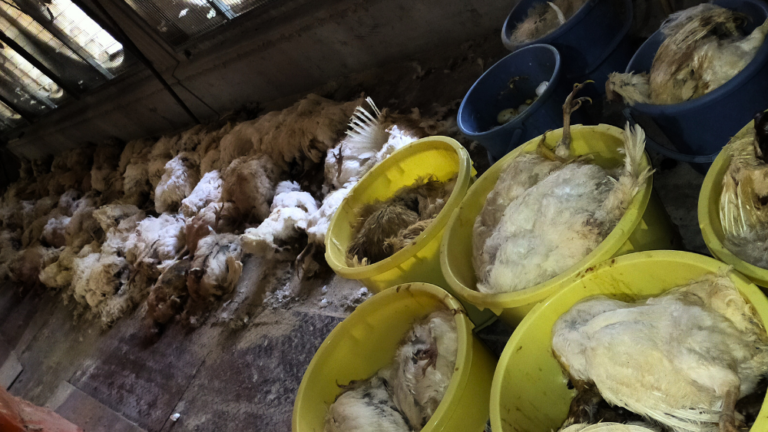
The Tokyo Olympics, the Osaka-Kansai Expo, and GREEN×EXPO 2027 all cite animal welfare in their procurement requirements for livestock products. However, none of them includes specific requirements that prohibit cage farming, gestation stalls, or the overcrowded rearing of broiler chickens.
Simply stating that one will “give consideration to animal welfare” will not change the animals’ rearing environments.
Progress made for the Osaka Expo has not been carried forward
For the 2025 Osaka-Kansai Expo, the Expo Association established standards that “recommend” livestock products certified under animal welfare certification schemes recognized by the Association. Under these standards, “Free-Range Egg Certification” (Eco Design Certification Center), which certifies production systems that do not confine laying hens in cages, was included.
Although it remained a recommendation rather than a requirement, it was a step toward valuing cage-free production in procurement.
However, the explanatory notes for GREEN×EXPO 2027’s livestock product procurement standards do not mention Free-Range Egg Certification. Moreover, the standards recommending animal welfare certification—and the mechanism by which the Association would review and add certifications—have also been removed. Even the improvements achieved for the Osaka Expo have not been carried forward, which can be described as a regression.
Even as international events accumulate, the situation for animals does not change
GREEN×EXPO 2027’s standards call for appropriate measures in light of the Terrestrial Animal Health Code of the World Organisation for Animal Health (formerly the OIE), among others. In Japan, however, the mechanism is to apply the Ministry of Agriculture, Forestry and Fisheries’ husbandry management guidelines’ “recommended practices.”
The Ministry’s guidelines state that welfare for laying hens “can be achieved through various housing systems,” and they do not mandate a transition to cage-free systems or to gestation-stall-free production. In addition, the ability to use perches, dust-bathing areas, and nest boxes, as well as sufficient rearing space, are categorized as “recommended practices for future implementation.” Because GREEN×EXPO references only the “recommended practices,” these items are not even included in the procurement requirements.
International events are an excellent opportunity to disseminate higher animal welfare standards. Nevertheless, Japan has effectively repeated the same level of procurement standards since 2020.
At a minimum, the following should be required for future international events held in Japan.
- Formally recognize animal welfare certifications such as Free-Range Egg Certification
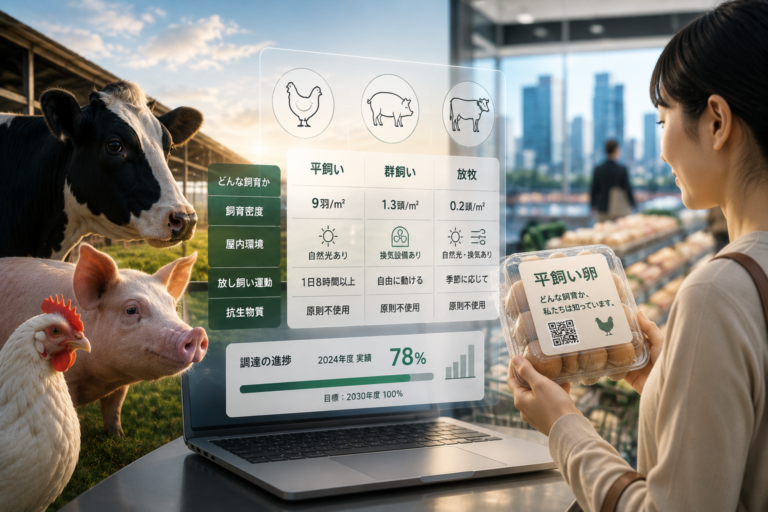
- Set procurement targets for cage-free eggs, gestation-stall-free pork, and chicken meat produced with improved conditions to address overcrowding
- Publish procurement performance results
The “sustainability” of international events should be demonstrated not through words, but by tangible improvements in the animals’ rearing environments.
Sources
- Tokyo 2020 “Explanatory Notes on the Procurement Standards for Livestock Products”
https://www.2020games.metro.tokyo.lg.jp/special/docs/%E7%95%9C%E7%94%A3%E7%89%A9%E3%81%AE%E8%AA%BF%E9%81%94%E5%9F%BA%E6%BA%96%20%E8%A7%A3%E8%AA%AC.pdf - Osaka-Kansai Expo “Explanatory Notes on the Sustainable Procurement Code (3rd Edition)
” (May 2024)
https://www.expo2025.or.jp/wp/wp-content/themes/expo2025orjp_2023/assets/pdf/sustainability/sus_code_docs_12.pdf - Osaka-Kansai Expo “List of Certification Schemes Recognized by the Expo Association” (updated November 7, 2025)
https://www.expo2025.or.jp/wp/wp-content/themes/expo2025orjp_2022/assets/pdf/sustainability/scheme.pdf - GREEN×EXPO 2027 “Explanatory Notes on the Sustainable Procurement Code
” (August 2026)
https://expo2027yokohama.or.jp/assets/docs/sustainability/440_code_chikusan260810.pdf - Ministry of Agriculture, Forestry and Fisheries “Technical Guidelines on the Husbandry Management of Laying Hens” (July 2023)
https://www.maff.go.jp/j/chikusan/sinko/attach/pdf/animal_welfare-132.pdf