
Kushihara Pig Farm Gobal
June 16, 2026
Interview conducted at Yama no Ham Koubou Gobal
Gen Ishihara of Kushihara Pig Farm
Ryota Tanaka of Gobal
Gen Ishihara runs Kushihara Pig Farm in the Kushihara district of Ena City, Gifu Prefecture, and Ryota Tanaka processes and sells its pork at Yama no Ham Koubou Gobal, one of the farm’s shipping destinations.
The Animal Rights Center Japan newsletter team spoke with both of them for our third issue. This article presents the more technical portions of that conversation.
Read the interview here
Q: You overcame the tragic experience of having to cull your entire herd due to classical swine fever. What were your farming methods like before that happened?
A: Mr. Ishihara
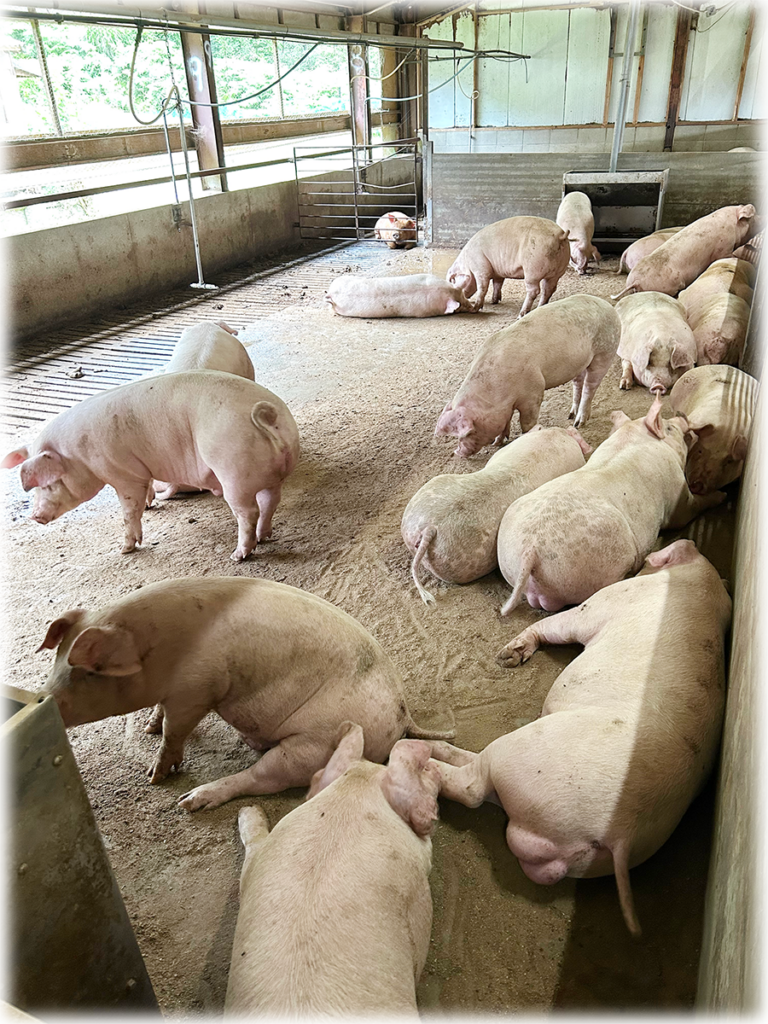
Originally, there were farmers in Kushihara already raising pigs, and I took over the farm they had built. It was what you’d call conventional (factory-style) pig farming, so even back then I had doubts about things like gestation crates and wanted to change them. That’s why I started working on group housing for pregnant sows.
Specifically, there was a free space behind the crates about 1.5 times the size of the crate itself, so I would normally open the back gate and let the pigs sleep there. The water dispensers were outside, so I also changed where they drank water and relieved themselves. Basically, since the pigs had nothing else to do, they just slept.
At the time, we shipped about 40% to Gobal and 60% to other production groups, and without the ability to really change that flow while still keeping the business running, that was about as much as I could do.
A: Mr. Tanaka
You also built a deep-litter area enclosed with wooden frames so they could move around freely, right? You really had to think hard about how to renovate an old-style pig barn while the pigs were still living in it.
A: Mr. Ishihara
But since the idea back then was simply “as long as they can move around, that’s fine,” problems like fighting started happening, so it didn’t go very well.
Q: You now practice animal welfare, and I understand you’ve also stopped surgical castration?
A: Mr. Ishihara
It started from wanting to let the sows build nests.
I think the ideal method would be to properly anesthetize the piglets, surgically remove the testicles, and then suture the wound. I understand that’s how it used to be done, but once farrowing environments shifted to raised slatted floors and became much more sanitary, it became standard practice to perform the current method of surgical castration (cutting open the scrotum without anesthesia and pulling out and cutting off the testicles) right after birth without much issue.
But to let the sows build nests, you need to use materials like straw, which inevitably introduces organic matter and bacteria into the farrowing environment. If you perform surgical castration in that environment, bacteria quickly enter the wound, causing hygiene problems and raising piglet mortality.
When I first tried surgical castration myself, some piglets ended up dying.
So, since I already had information about Improvac (currently the only product available for immunological castration of pigs), I decided to try it and started working with it.
[About Improvac]
Developed in Australia, it is approved in more than 60 countries worldwide.
In Japan, immunological castration products for pigs were approved by the Ministry of Agriculture, Forestry and Fisheries as veterinary pharmaceuticals in 2010. A representative product is Zoetis Japan’s Improvac, and the Food Safety Commission has also confirmed the safety of the resulting pork.
▪️Manufactured and sold by
Zoetis Japan K.K.
▪️Effects and mechanism
This is an immunological castration product that acts on the pig’s immune system to generate specific antibodies against GnRH (gonadotropin-releasing hormone), which controls testicular development and function. This temporarily suppresses testicular function, which in turn suppresses the production and accumulation of compounds that cause boar taint.
- Male pigs: Immunological castration effect and suppression of boar taint in pork
- Female pigs: Immunological suppression of estrus (suppression of ovarian function)
Q: There’s been talk that surgical castration causes piglets to scream, which stresses out the sows. How have the sows seemed since you stopped surgical castration?
A: Mr. Ishihara
In the early days after switching to free-stall housing, we were still doing surgical castration.
Not only did organic matter get on the wounds, but the sows also got extremely agitated. When a sow got angry and there was no crate to separate her, it was dangerous for the people working there, and that was part of why we switched to immunological castration.
Q: What made it possible for you to stop surgical castration?
A: Mr. Ishihara
Right now, it seems some breeding farms use Improvac, but in the general market many people still don’t know about it, and the reaction is often, “What’s that? That sounds suspicious.” In fact, even now, no one other than Gobal will buy our male pigs. We’re often told to just produce females instead.
Even so, the reason I felt I could take on this challenge was that almost 100% of our shipments went to Gobal, so I felt that as long as I got their understanding, it would work. If it had been, say, 50% Gobal and 50% elsewhere, it might not have been possible.
A: Mr. Tanaka
We get more inquiries from natural-food co-ops in Shikoku or health-conscious, additive-free shops in cities like Tokyo than from local buyers.
Also, we’ve been doing mail order since before the internet existed, originally through a printed newsletter. Thankfully, sales have become fairly steady on average now.
Q: What do you feel about using immunological castration?
A: Mr. Ishihara
What I appreciate is, first of all, that it reduces suffering, so it’s kinder to the pigs. Also, since they aren’t castrated, they grow as intact males, which means faster growth and a better meat balance. When pigs are castrated, the energy that would go toward sexual maturity instead goes into fat, making the fat layer thicker. With this method, the fat stays at a moderate thickness, giving a better balance with the lean meat.
What I find difficult is that the timing of sexual maturity and the effectiveness of the treatment vary by individual, so there’s some inconsistency in results. If it works well, there’s no problem, but if it doesn’t work well on a particular pig, that pig may start mounting weaker pigs or become aggressive, causing trouble for the others. And if it doesn’t work well, boar taint—the very thing we’re trying to prevent—can remain.
Also, it’s demanding because you have to give two injections, and you need to carefully plan the timing between the first and second doses, as well as the withdrawal period between the second dose and shipping, so that the treatment is still effective when the pig is shipped. Surgical castration is far easier in comparison.
On top of that, immunity tends to drop after the injection. Sometimes bacteria get into the injection site and it becomes infected, or a lump can remain at the site. Still, considering the damage and pain this spares the pigs, I think this injection method is better.
A: Mr. Tanaka
They say only about one in five people can actually notice boar taint, but I was one of those people—I found it too smelly to eat, and I always wanted to do something about it. With our current method, we’re able to eliminate boar taint without castration, and the meat balance improves as well. Because of that, I feel like we’re starting to see a real possibility of male pigs being accepted more widely in the market going forward.
Q: Since switching to free farrowing stalls and moving to open communal rearing from the second week, how have the sows and piglets been doing?
A: Mr. Ishihara
Honestly, I can’t say with confidence that everything has gone well. Giving the pigs more freedom has significantly increased the rate of piglets dying from crushing, compared to when we used farrowing crates. We expected some increase, but it’s been higher than anticipated. Right now, we’re gradually identifying the problems, and we’re working on improvements while taking whatever measures we can to reduce these accidents.
Q: What causes these piglet accidents, and what improvements are you making to reduce them?
A: Mr. Ishihara
What I find most troublesome is the summer heat.
Japan’s humid climate just doesn’t seem to suit pigs well.
Pigs don’t have sweat glands to cool their bodies, so they can’t release heat effectively. The heat makes them less attentive, and I think it also makes them irritable when piglets cling around their feet. In fact, sows that normally raise their piglets well often struggle during the summer.
Overall, they do poorly in summer and well in winter.
We try various heat countermeasures, like using fans or spraying water, but the climate itself is getting harsher every year, and Kushihara has gotten noticeably hotter than it used to be.
Since we can’t change the climate, we’ve considered options like not allowing farrowing during the summer, but realistically, it’s hard to say whether that’s feasible.
Since removing the crates that used to restrict the pigs’ behavior, their individual personalities have really come through, which is interesting in its own way—but personalities vary a lot. Some sows raise their piglets skillfully, while others show little interest in caring for them and are rather lazy about it.
The challenge is how well we can respond to each individual sow’s personality. What we’re trying to do is identify which sows are suited to raising piglets and which aren’t, so that we can avoid keeping sows that aren’t good at it and instead keep only the sows that raise their piglets well.
Q: Is that determination mainly based on day-to-day observation?
A: Mr. Ishihara
Yes, observation plays a role, but there may also be a genetic factor involved. I think the crushing problem isn’t purely a physical or structural issue—it’s also a breeding issue.
Mainstream pig breeding up to now has focused on things like “how quickly can we fatten them” or “how many piglets can a sow produce,” and traits like “being a good mother” don’t seem to have been part of the breeding goals at all. That might also be related to factors like milk yield.
Since we don’t really know what the key factors are for good mothering, right now, when ordering semen from breeding companies, we’re experimenting by specifying things like “strong legs and hooves are important too.”
Generally speaking, the breeding policy for sows worldwide has focused on “high-prolificacy lines,” aiming to increase litter size. In the early days, we also raised some high-prolificacy sows, and while some of them were good mothers, many piglets from these lines didn’t survive well.
So I think there are both breeding issues and numerical issues at play here.
That said, genetic research is now revealing things like “this gene sequence is associated with this trait” or “this trait corresponds to this gene sequence,” and what used to rely on intuition and experience is gradually shifting toward more efficient selection of superior breeding stock using genetic testing.
Of course, applying that kind of thinking to humans would lead to eugenics or discrimination, so this is strictly selection for the purpose of food production.
Another issue is how to form good social groups among the sows. Ideally, you’d keep them by family (groups from the same maternal line) and not mix in individuals from other maternal lines, but our current setup doesn’t really allow for that, so that’s another area where we face challenges.
This issue tends to come up during the roughly one-month period of communal rearing after farrowing. Success there depends a lot on how well the sows get along with each other. When they all get along, if one sow makes the distinctive call associated with nursing, the other sows tend to start nursing too, so fewer piglets miss out on milk and things go smoothly.
But if there are sows being bullied or sows with difficult temperaments among the group, that doesn’t happen, and piglets that miss out on nursing end up clinging around the sows’ feet, where they can accidentally get crushed, leading to accidents.
Q: Are there any facility-based measures as well?
A: Mr. Ishihara
We’ve installed crush-protection equipment that piglets can escape into, and we do what we can there. I also think something like a crush-protection partition could help, but honestly, I feel individual differences among the sows probably have a bigger impact.
Even using the same facilities, some sows manage well and others don’t, and even the same sow can struggle during the summer.
Q: You don’t clip teeth, though that has its own drawbacks—it’s a trade-off either way
A: Mr. Ishihara
We don’t do teeth clipping either, but not doing it has the downside of injuring the udder, especially causing mastitis in the rear teats. Because of what’s called “teat order,” the ranking of teats gets established within a few days, with stronger piglets claiming the more productive front teats, which means weaker piglets end up fighting over the less productive rear teats, scraping and injuring themselves in the process.
If they nurse properly, there’s no injury.
If you are going to clip teeth, it should be done carefully, like a dentist filing them down, but in most operations, people use dull nippers and just snap them off roughly, which can crack all the way into the gums and cause the mouth to become infected. That’s simply unacceptable—it’s really a matter of skill.
Q: Fighting and hierarchy formation among sows
A: Mr. Ishihara
We have to introduce young gilts into the sow herd as they become sows themselves, and that’s when the biggest problems occur. When a newcomer joins, fighting breaks out, and it’s quite intense. They don’t fight with the strongest sows, but fighting breaks out lower in the hierarchy. Once the ranking is settled and they recognize each other, things calm down. But dealing with this really requires maintaining the same maternal-line groups consistently over time, which would require major facility investment, so it’s difficult to address right away.
Q: Can you tell us about your use of antibiotics?
A: Mr. Ishihara
There are two types of antibiotic use. One is when antibiotics are mixed into feed at the feed factory in advance, under the pretext of “growth promotion” or “disease prevention,” and the other is when antibiotics are used to treat an actual illness. We use antibiotics for treatment purposes, but we don’t use the kind that are pre-mixed into feed.
Q: Do you have any specific standards regarding slaughter?
A: Mr. Ishihara
Of course, the shorter the transport time, the better, and same-day lairage is preferable too. The pigs arrive at the slaughterhouse a little after 8 a.m., and by the morning they’ve already been processed into meat, so as it stands, we’re able to meet that standard.
A: Mr. Tanaka
Before we switched to our current method, the slaughterhouse was in Gifu, about two and a half hours away by highway, but now it’s less than an hour from here. We happen to be able to choose between two slaughterhouses here, but in general, Japan doesn’t have many slaughterhouses, so there’s often no choice at all—you can’t just take your pigs to whichever slaughterhouse you prefer. Right now, since the facility is quite small, there are also limits on the number of animals it can handle.
Q: There’s the issue of pigs not being able to drink water during transport or at the lairage
A: Mr. Tanaka
Gen gives them water even the day before, but the reason the water is withheld before slaughter is that the kidneys remain attached even after slaughter, so if there’s water inside, urine can leak out when the carcass is split, causing the meat to smell.
Normally, the urine in the kidneys is clean and odorless, but if it leaks out and sits for a while, it becomes very smelly. If it’s washed off right away, there’s no problem, but if management isn’t thorough and no one notices where the urine landed, it can be left as is, causing issues.
But because we have this kind of trust with Gen’s farm, it’s not a problem for us.
Q: On the legal revision regarding “selective culling” in the event of a classical swine fever outbreak
A: Mr. Ishihara
Since movement is banned for three months, the pigs would grow very large, making it impossible to ship them normally, so there would be a lot of details to work out, like what to do with the remaining pigs.
Still, it’s better than culling the entire herd.
There are other serious diseases too, like PRRS (porcine reproductive and respiratory syndrome, one of the biggest threats in the pig farming industry), and I find it strange that diseases like that aren’t classified as “legally designated infectious diseases.”
[National Legal Reform and the Introduction of Selective Culling]
Revision of the Act on Domestic Animal Infectious Diseases Control (effective May 19, 2026)
▪️Review of culling policy
In classical swine fever vaccination zones (prefectures other than Hokkaido), it was previously mandatory to cull the entire herd (“total culling”) on any farm where an outbreak occurred. Going forward, a new “selective culling” policy has been introduced, under which only pigs that pose a risk of spreading the disease (specifically, piglets and pigs that test positive or show symptoms) will be culled.
Q: How challenging is this from a business perspective?
A: Mr. Tanaka
Naturally, using good feed costs more, and prioritizing animal welfare over production efficiency means lower shipment volumes, so figuring out how to reflect that in pricing is really difficult.
Normally, pig prices are set by auction and bought at that price, but Gobal and Kushihara Pig Farm agree on a fixed price between the two of us, buying at the same price whether times are good or bad. From the farm’s perspective, that means a flat price even as costs keep rising, which must be tough.
At the same time, it’s not easy for Gobal to simply raise prices right away to reflect that either, so it’s a difficult balance.
But I work on processing and sales with Gobal’s philosophy of “living is sharing” in mind, and I think the way Gen and his wife Noa run their farm—with a clear set of values, genuinely enjoying raising their pigs, and wanting to share that with others—is itself a form of animal welfare.
Rather than just chasing efficiency for the sake of profit, I think what matters is raising and producing in a way you’re not ashamed to explain to consumers, and then being open and honest about it with them, without hiding anything.
Q: What are your thoughts on the livestock industry today?
A: Mr. Ishihara
In terms of broader issues, livestock farming places a huge burden on the global environment, and at this point, it’s become unclear what the feed is even being produced for.
One question is whether we really need this much livestock in the first place, and another is that grain itself has become an object of futures trading, so it feels like it’s being driven by factors that have nothing to do with food. A lot of the grain is also genetically modified, and no one really knows whether that’s truly safe or what will happen with it in the future, which is frightening.
North America has already become desertified, and South America is clearing forests for grain production. There are supposedly regulations, but it seems like things keep advancing without any real brakes.
We’re a small part of that larger flow, but we’re still involved in it, and it makes me wonder. Changing it would mean living very differently, but within that larger trend, we’re working on animal welfare in hopes of finding some way that both the animals and the people involved in raising them don’t have to push themselves so hard.